Image: 34.3 x 22.5 cm / 13 1/2 x 8 7/8 in / Paper: 35.6 x 27.9 cm / 14 x 11 in
Saul Leiter Foundation copyright stamp dated "2022" with signature in pencil by Margit Erb, director, on label and Saul Leiter Foundation edition stamp with print date and edition number in pencil on label affixed to print verso
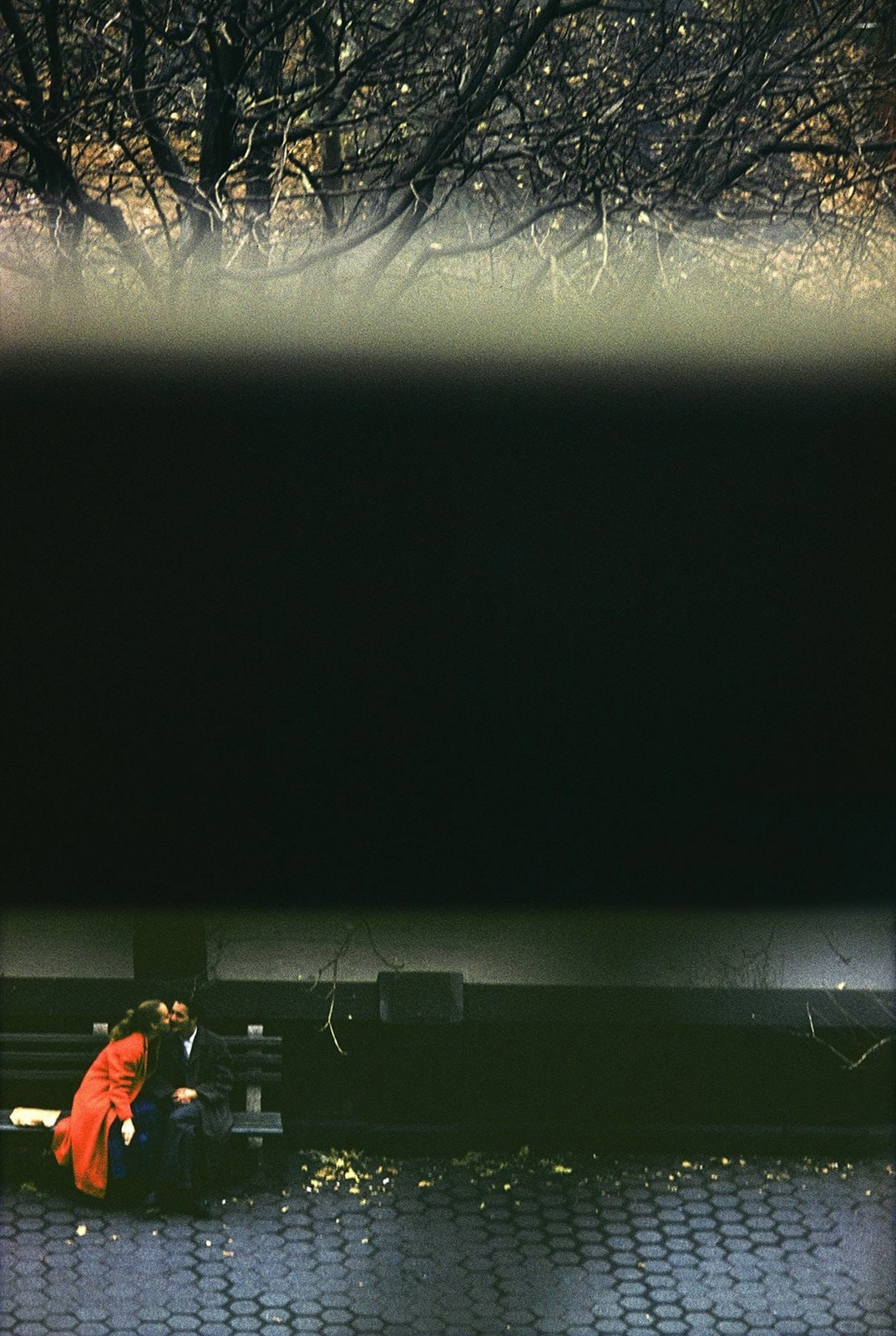
You wait the longest time for the people to arrive, and when they do they're almost not there. The eye goes first to the top, to that band of fog snagged in the winter branches, and then comes the wall — an enormous slab of near-black that eats two thirds of the picture and offers nothing, no detail, no window, just the city declining to explain itself. Most photographers would never dare hand over so much of a frame to plain darkness. Saul Leiter does it the way a painter leaves a canvas mostly unpainted, trusting that the one charged inch will hold.
And it does. Down in the lower-left corner, half-swallowed by shadow, a couple sits on a park bench, the woman leaning into the man, her red coat burning against the wet cobblestones like the single lit thing for blocks. Spent leaves are scattered across the stones. You have to hunt for the tenderness here — it's been tucked into the margin on purpose, made small, nearly erased — and the hunting is the point. The black isn't empty after all. It's the distance you cross to find them.
Leiter worked these Manhattan blocks from the early 1950s in color, which the art world ignored for some forty years before deciding he belonged in it, with prints now at the Whitney, the Art Institute of Chicago, and the Museum of Fine Arts, Houston. This chromogenic print, in an edition of twenty, holds the whole painter's logic of his looking: color first, story second, one red coat found in an ocean of dark.

You wait the longest time for the people to arrive, and when they do they're almost not there. The eye goes first to the top, to that band of fog snagged in the winter branches, and then comes the wall — an enormous slab of near-black that eats two thirds of the picture and offers nothing, no detail, no window, just the city declining to explain itself. Most photographers would never dare hand over so much of a frame to plain darkness. Saul Leiter does it the way a painter leaves a canvas mostly unpainted, trusting that the one charged inch will hold.
And it does. Down in the lower-left corner, half-swallowed by shadow, a couple sits on a park bench, the woman leaning into the man, her red coat burning against the wet cobblestones like the single lit thing for blocks. Spent leaves are scattered across the stones. You have to hunt for the tenderness here — it's been tucked into the margin on purpose, made small, nearly erased — and the hunting is the point. The black isn't empty after all. It's the distance you cross to find them.
Leiter worked these Manhattan blocks from the early 1950s in color, which the art world ignored for some forty years before deciding he belonged in it, with prints now at the Whitney, the Art Institute of Chicago, and the Museum of Fine Arts, Houston. This chromogenic print, in an edition of twenty, holds the whole painter's logic of his looking: color first, story second, one red coat found in an ocean of dark.