The smallest legible thing in the picture is the word that matters: VACANCY, spelled in modest orange neon beneath the tall letters of MOTEL. Everything else has surrendered its outline: rain on the window scatters the sign into violet and magenta discs that drift up the left of the frame like paper lanterns, and the scripted name above the big letters softens past reading. A single wire crosses the dark on the diagonal, the one straight line the night allows.
As a nocturne it is rigorously constructed from almost nothing: a field of deep, breathing black; two temperatures of artificial light, the cool blue-white of the upper tubes and the hot red-orange below; and the wet interference of glass between camera and subject. The blur is not carelessness but method, the means by which a roadside sign becomes an apparition. American photography has long been drawn to the motel at night, emblem of transience and small promise; here that tradition is distilled to its glowing minimum, a word offering shelter to no one visible.
The photographer, born in Kent, Ohio in 1968 and working from the San Francisco Bay Area, has built one of contemporary photography’s most recognizable nocturnal worlds, from lamplit suburban houses to roads dissolving beyond a wet windshield; this frame, numbered 10759-1221 after his habit of counting rather than naming, extends that world to the vernacular sign. His prints rest in the collections of SFMOMA, the Getty and the Whitney. In the archival pigment print the neon holds its saturation against a black that stays generous and deep, so the small word keeps burning.
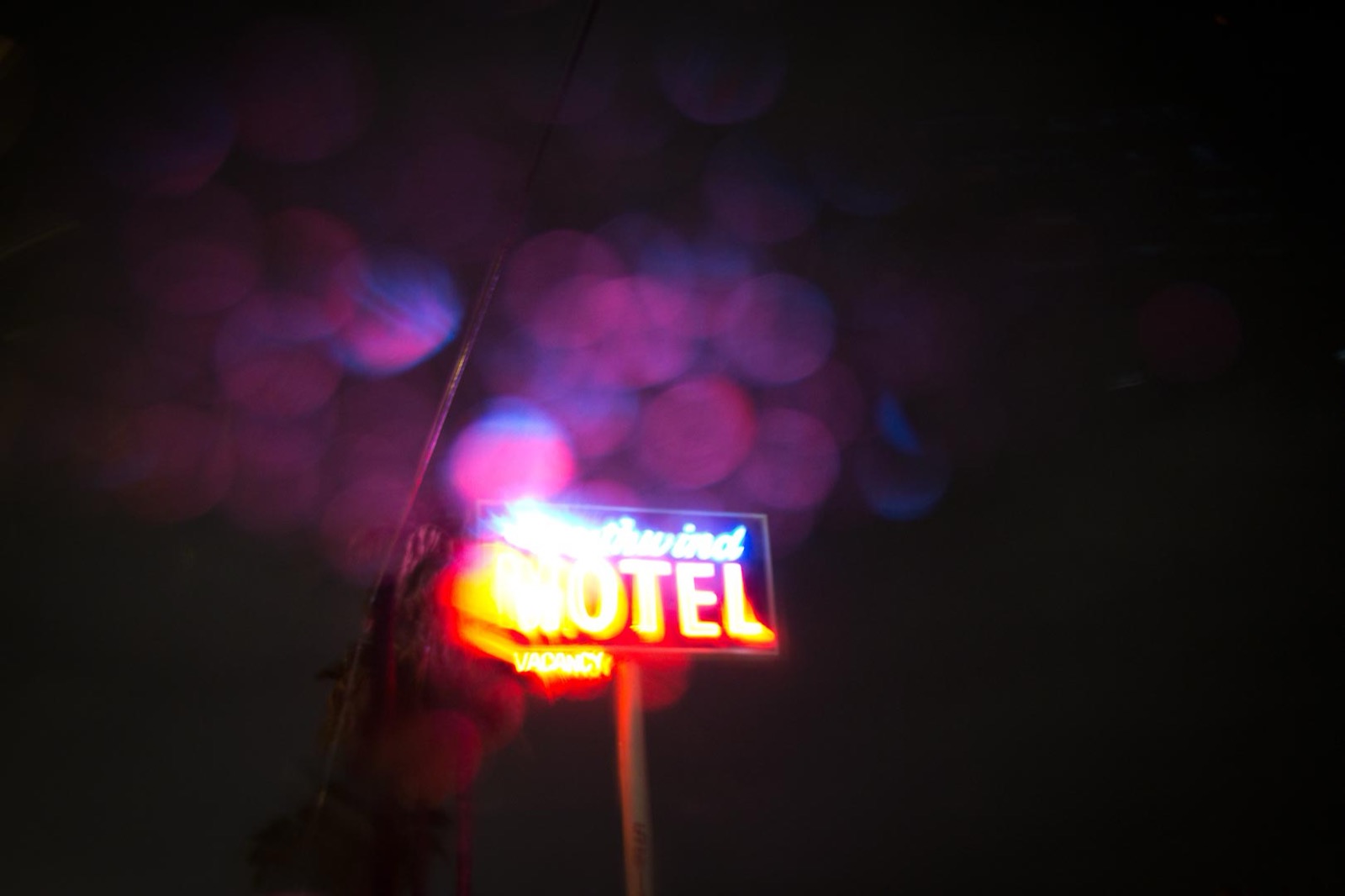

The smallest legible thing in the picture is the word that matters: VACANCY, spelled in modest orange neon beneath the tall letters of MOTEL. Everything else has surrendered its outline: rain on the window scatters the sign into violet and magenta discs that drift up the left of the frame like paper lanterns, and the scripted name above the big letters softens past reading. A single wire crosses the dark on the diagonal, the one straight line the night allows.
As a nocturne it is rigorously constructed from almost nothing: a field of deep, breathing black; two temperatures of artificial light, the cool blue-white of the upper tubes and the hot red-orange below; and the wet interference of glass between camera and subject. The blur is not carelessness but method, the means by which a roadside sign becomes an apparition. American photography has long been drawn to the motel at night, emblem of transience and small promise; here that tradition is distilled to its glowing minimum, a word offering shelter to no one visible.
The photographer, born in Kent, Ohio in 1968 and working from the San Francisco Bay Area, has built one of contemporary photography’s most recognizable nocturnal worlds, from lamplit suburban houses to roads dissolving beyond a wet windshield; this frame, numbered 10759-1221 after his habit of counting rather than naming, extends that world to the vernacular sign. His prints rest in the collections of SFMOMA, the Getty and the Whitney. In the archival pigment print the neon holds its saturation against a black that stays generous and deep, so the small word keeps burning.