Image: 34.3 x 22.5 cm / 13 1/2 x 8 7/8 in / Paper: 35.6 x 27.9 cm / 14 x 11 in
Saul Leiter Foundation copyright stamp dated "2022" with signature in pencil by Margit Erb, director, on label and Saul Leiter Foundation edition stamp with print date and edition number in pencil on label affixed to print verso
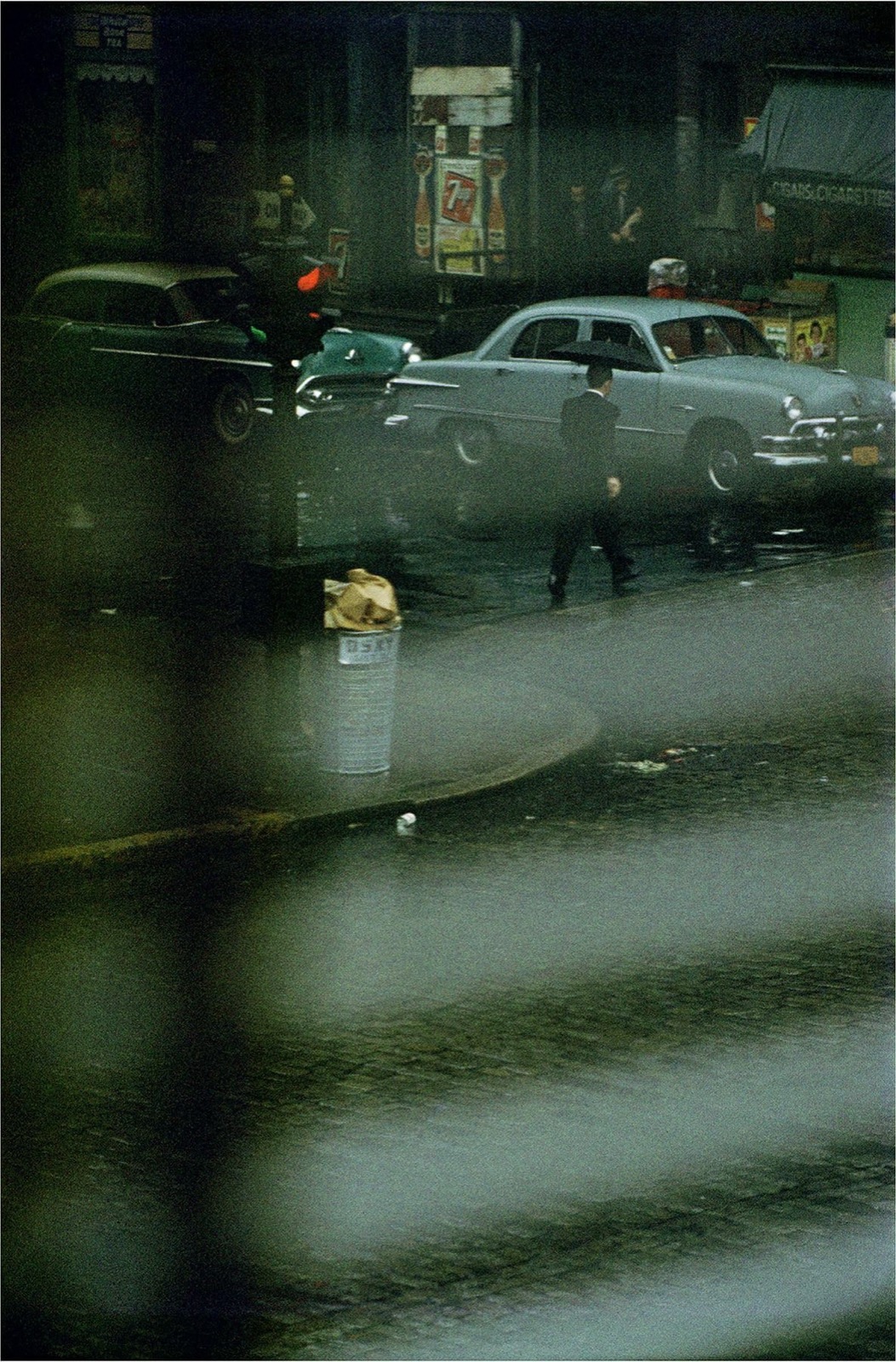
Bleeding. The lower third of this chromogenic print is dissolving into a vertical smear of greens and bruised slate, the wet street and a near pane of glass collapsed into one another until the cobblestones stop being cobblestones and become emulsion itself — dye clouds suspended, refusing to resolve. The eye keeps reaching for purchase and keeps sliding off, because the picture withholds the very crispness we expect a camera to deliver. That withholding is the subject. Kodachrome, with its layered couplers and its saturated, slightly sealed-in color, was a film built for the bright and the legible; here it is conscripted into murk, into a New York rinsed of contour.
What survives the blur arrives like contraband. A man in a dark coat steps between two cars mid-stride, one foot lifted, never to land — the apparatus has fixed him in a crossing that the print preserves forever wet. A pale Ford sedan, a darker coupe nosed behind it, a brown paper bag slumped atop a white wire trash can, the red dots of a 7-Up sign, the words CIGARS CIGARETTES holding the far wall. These are not seen so much as developed: pulled up out of the chemistry the way a latent image is coaxed from a sheet by the bath.
That this object exists at all is the second marvel. The transparency sat for decades; the work belongs to the celebrated postwar color pictures made on these blocks long before color was admitted to the museum, and this sheet was printed in 2022, a chromogenic translation of the small original. What you hold is doubly made — once by the street, once by the darkroom that finally let the dyes breathe at scale. The fog was always in the negative. The print gives it a body.
Bleeding. The lower third of this chromogenic print is dissolving into a vertical smear of greens and bruised slate, the wet street and a near pane of glass collapsed into one another until the cobblestones stop being cobblestones and become emulsion itself — dye clouds suspended, refusing to resolve. The eye keeps reaching for purchase and keeps sliding off, because the picture withholds the very crispness we expect a camera to deliver. That withholding is the subject. Kodachrome, with its layered couplers and its saturated, slightly sealed-in color, was a film built for the bright and the legible; here it is conscripted into murk, into a New York rinsed of contour.
What survives the blur arrives like contraband. A man in a dark coat steps between two cars mid-stride, one foot lifted, never to land — the apparatus has fixed him in a crossing that the print preserves forever wet. A pale Ford sedan, a darker coupe nosed behind it, a brown paper bag slumped atop a white wire trash can, the red dots of a 7-Up sign, the words CIGARS CIGARETTES holding the far wall. These are not seen so much as developed: pulled up out of the chemistry the way a latent image is coaxed from a sheet by the bath.
That this object exists at all is the second marvel. The transparency sat for decades; the work belongs to the celebrated postwar color pictures made on these blocks long before color was admitted to the museum, and this sheet was printed in 2022, a chromogenic translation of the small original. What you hold is doubly made — once by the street, once by the darkroom that finally let the dyes breathe at scale. The fog was always in the negative. The print gives it a body.