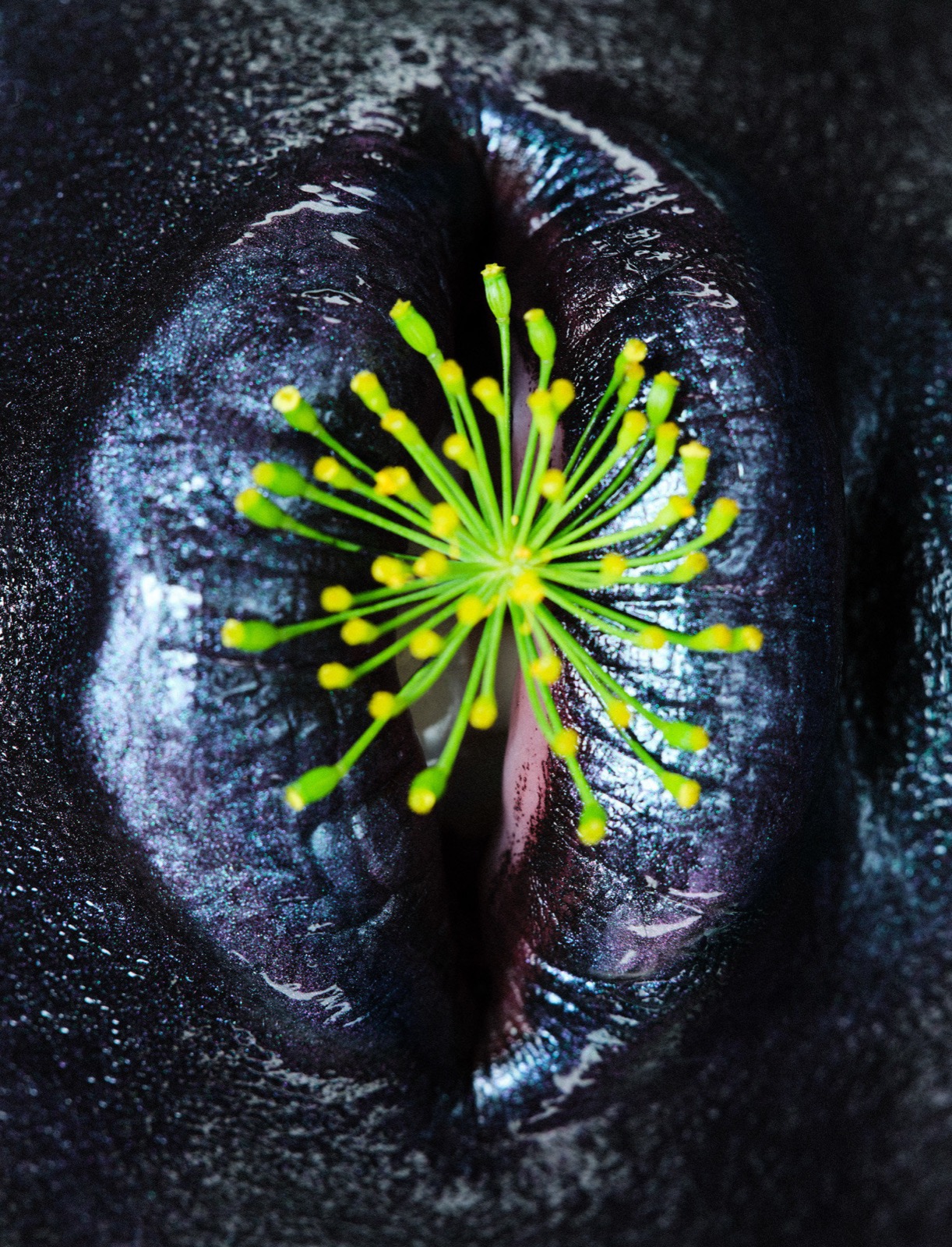
An instant earlier the lips must have closed around the stem; an instant later a breath could scatter the whole green burst. Yeste holds the mouth exactly between, parted just enough to release a spray of slender filaments, each tipped with a bead of yellow pollen, radiating from a single point like a sea urchin or a struck firework. The lips themselves are lacquered a deep glittering black, wet and cracked with light, flecked silver where the studio lamp skids across them.
Photographed this close, the body stops being a body and becomes landscape and still life at once. The tonal drama is severe: a near-total black, dense as wet slate, against the acid green and citrus yellow of the flower’s core, colors that seem to generate their own light. It recalls the great botanical close-ups, the way a stamen enlarged becomes a diagram of desire, and the surrealist appetite for the mouth as a threshold. Nothing is decorative here; every filament earns its place in the grid of the frame.
Yeste rose to the front rank of Spanish fashion photography, in Numéro, Harper’s Bazaar and Vogue, and this image distills his recurring theme, the meeting of the human and the elemental, to a single charged detail. The archival pigment print is essential here, holding the saturated greens and yellows at full pitch while keeping the black lips from collapsing into a void. Each speck of pollen stays crisp. What could have been a shock reads instead as a small, exact study of appetite and bloom, composed with a jeweler’s care.
An instant earlier the lips must have closed around the stem; an instant later a breath could scatter the whole green burst. Yeste holds the mouth exactly between, parted just enough to release a spray of slender filaments, each tipped with a bead of yellow pollen, radiating from a single point like a sea urchin or a struck firework. The lips themselves are lacquered a deep glittering black, wet and cracked with light, flecked silver where the studio lamp skids across them.
Photographed this close, the body stops being a body and becomes landscape and still life at once. The tonal drama is severe: a near-total black, dense as wet slate, against the acid green and citrus yellow of the flower’s core, colors that seem to generate their own light. It recalls the great botanical close-ups, the way a stamen enlarged becomes a diagram of desire, and the surrealist appetite for the mouth as a threshold. Nothing is decorative here; every filament earns its place in the grid of the frame.
Yeste rose to the front rank of Spanish fashion photography, in Numéro, Harper’s Bazaar and Vogue, and this image distills his recurring theme, the meeting of the human and the elemental, to a single charged detail. The archival pigment print is essential here, holding the saturated greens and yellows at full pitch while keeping the black lips from collapsing into a void. Each speck of pollen stays crisp. What could have been a shock reads instead as a small, exact study of appetite and bloom, composed with a jeweler’s care.