A single yellow window burns in the side of a clapboard house, the only warm light in a world gone green. Todd Hido shot 7373 in 2008 for his series Excerpts from Silver Meadows, and like all his nocturnes it turns an ordinary suburban corner into something closer to a film still than a document. Snow lies in torn patches across the driveway, tire tracks cut through it, an old sedan waits in the dark, and the whole scene glows with the sodium-vapor wash that has become his signature.
Hido works at night with long exposures and only the light that is already there, streetlamps, porch bulbs, the leak of a curtained room. He has described his method as shooting like a documentarian but printing like a painter, and the result here is uncanny, a real place rendered in colors that feel remembered rather than seen. The two pale houses lean close together, the gap between them pure shadow, and the lit window does the quiet work of the picture, telling us someone is home while leaving us outside in the cold, looking in.
These houses stand in for the Ohio of his childhood, surrogates for landscapes that exist mostly in memory. There is no event and no figure, only the sense that something has just happened or is about to, the loneliness of American suburbia pressed into a single frame, the mood that links him to Edward Hopper and to the opening shot of a thriller.
Hido is among the most collected photographers of his generation, his work held in the Guggenheim, the Whitney, and the San Francisco Museum of Modern Art. This nocturne distills his vision whole, the green night house, the empty drive, the one lit window that makes absence ache.
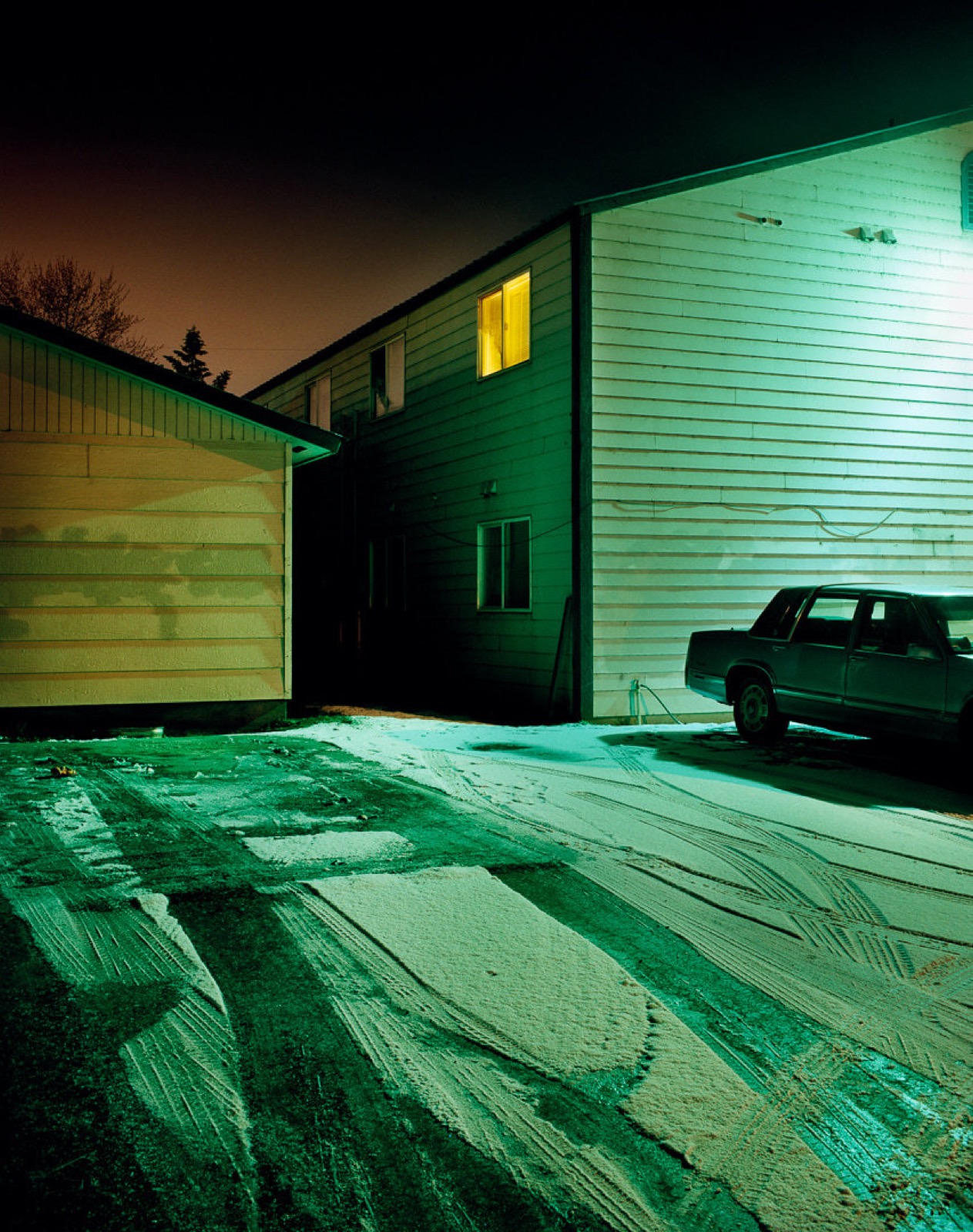

A single yellow window burns in the side of a clapboard house, the only warm light in a world gone green. Todd Hido shot 7373 in 2008 for his series Excerpts from Silver Meadows, and like all his nocturnes it turns an ordinary suburban corner into something closer to a film still than a document. Snow lies in torn patches across the driveway, tire tracks cut through it, an old sedan waits in the dark, and the whole scene glows with the sodium-vapor wash that has become his signature.
Hido works at night with long exposures and only the light that is already there, streetlamps, porch bulbs, the leak of a curtained room. He has described his method as shooting like a documentarian but printing like a painter, and the result here is uncanny, a real place rendered in colors that feel remembered rather than seen. The two pale houses lean close together, the gap between them pure shadow, and the lit window does the quiet work of the picture, telling us someone is home while leaving us outside in the cold, looking in.
These houses stand in for the Ohio of his childhood, surrogates for landscapes that exist mostly in memory. There is no event and no figure, only the sense that something has just happened or is about to, the loneliness of American suburbia pressed into a single frame, the mood that links him to Edward Hopper and to the opening shot of a thriller.
Hido is among the most collected photographers of his generation, his work held in the Guggenheim, the Whitney, and the San Francisco Museum of Modern Art. This nocturne distills his vision whole, the green night house, the empty drive, the one lit window that makes absence ache.