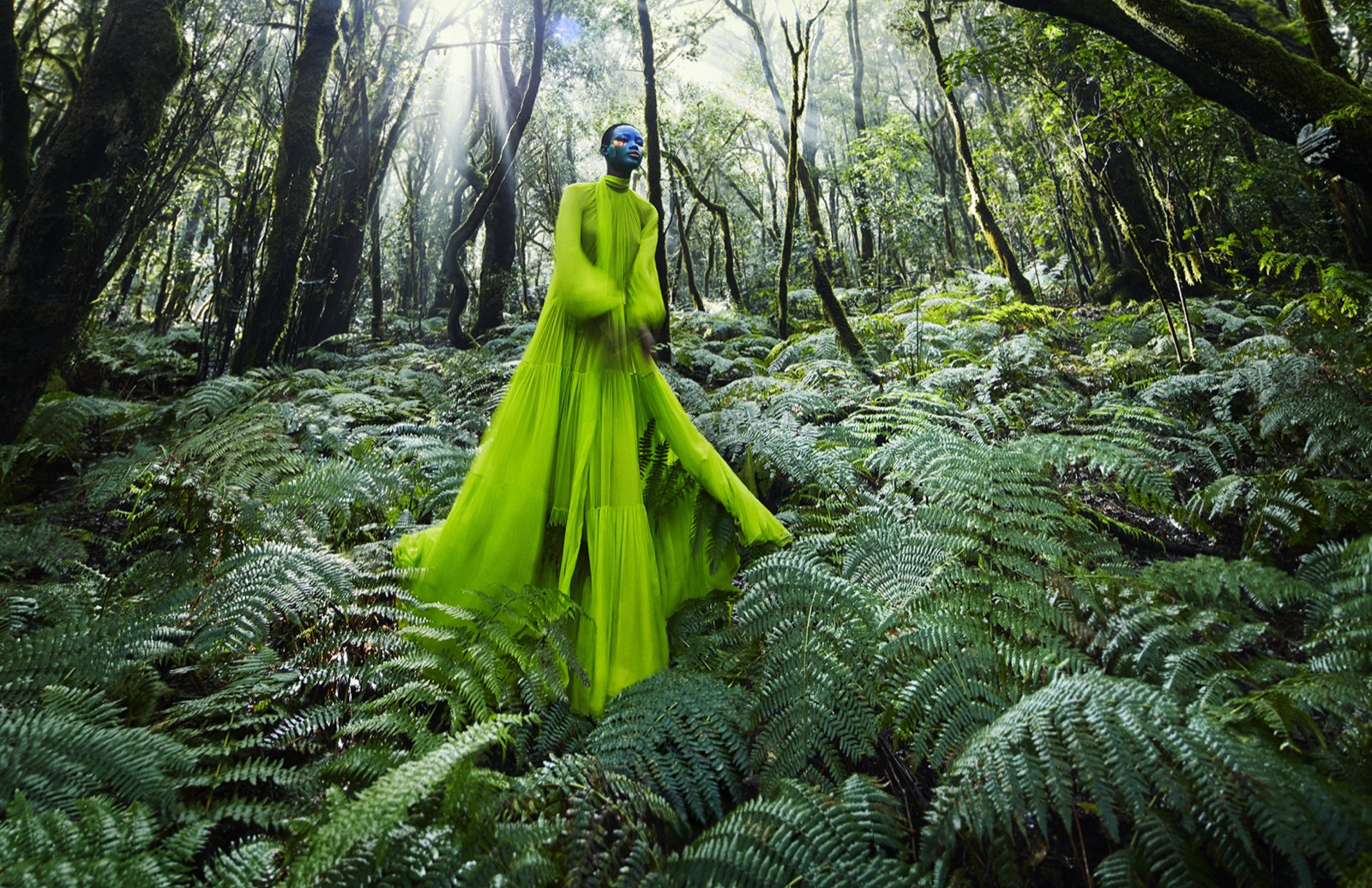
The light arrives in slanted shafts, the kind you only get when the air itself is wet enough to show them — sunbeams made visible by mist, sifting down between moss-furred trunks. It is less illumination than weather, a forest exhaling, and it turns the whole interior the underwater green of ferns. Into this, at the exact center, Yeste has set a woman in acid-green tulle, and the joke, if it is one, is how nearly she disappears.
She doesn’t, quite. Her gown is a degree too electric, chartreuse where the ferns are forest, and the mismatch is the point: camouflage that fails just enough to become spectacle. Her face is painted blue, tipped up toward the light like someone remembering where they last saw the sky. The tulle pools and lifts in the same slow way the mist moves, so that for a second you can’t tell whether she is dressed by the couturier or by the climate. Both, obviously.
Yeste made his name in the front rank of Spanish fashion — Numéro, Harper’s Bazaar, Vogue — but the elemental streak keeps pulling him off the seamless studio backdrop out into places like this, where the location does half the styling. The laurel forest, ancient and dripping, is a co-conspirator. What you’re looking at is a fashion picture that has quietly become a landscape, or the reverse; the argument is unresolved and better for it. As an archival pigment print the greens hold their full saturation, the shadows keep their moisture, and the shafts of light stay exactly as improbable as they were on the morning they fell.
The light arrives in slanted shafts, the kind you only get when the air itself is wet enough to show them — sunbeams made visible by mist, sifting down between moss-furred trunks. It is less illumination than weather, a forest exhaling, and it turns the whole interior the underwater green of ferns. Into this, at the exact center, Yeste has set a woman in acid-green tulle, and the joke, if it is one, is how nearly she disappears.
She doesn’t, quite. Her gown is a degree too electric, chartreuse where the ferns are forest, and the mismatch is the point: camouflage that fails just enough to become spectacle. Her face is painted blue, tipped up toward the light like someone remembering where they last saw the sky. The tulle pools and lifts in the same slow way the mist moves, so that for a second you can’t tell whether she is dressed by the couturier or by the climate. Both, obviously.
Yeste made his name in the front rank of Spanish fashion — Numéro, Harper’s Bazaar, Vogue — but the elemental streak keeps pulling him off the seamless studio backdrop out into places like this, where the location does half the styling. The laurel forest, ancient and dripping, is a co-conspirator. What you’re looking at is a fashion picture that has quietly become a landscape, or the reverse; the argument is unresolved and better for it. As an archival pigment print the greens hold their full saturation, the shadows keep their moisture, and the shafts of light stay exactly as improbable as they were on the morning they fell.