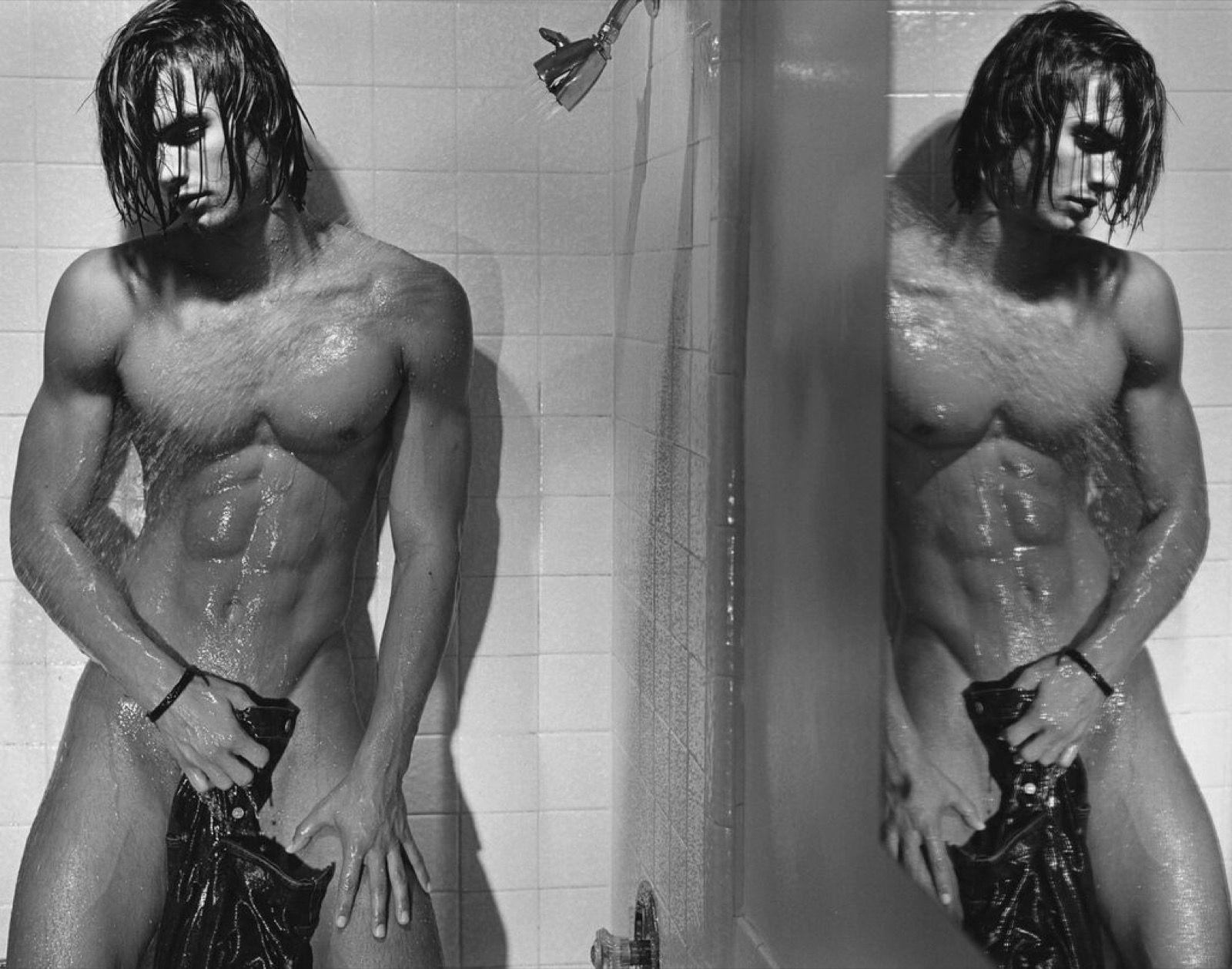
Why does the picture give us the same man twice? A wet, muscled figure stands in a tiled shower at the left, then again at the right, hair plastered across the face, a fistful of soaked denim held low across the body, a chrome showerhead presiding between them. A pale seam of wall divides the two panels like the fold of a magazine spread. The doubling is no accident of printing; it is the image thinking aloud about repetition, the way advertising multiplies a body until it hardens into a sign you can buy.
And a sign is what this became. Made as fashion was rediscovering the male form as pure commercial desire, it hands us the full grammar of that moment: water as a licence to look, the wet jeans standing in for the label, the face hidden so the physique can speak for the brand. Streaks of water run the length of the torso, catching the light like applied highlights. The tiled wall behind runs its grid like graph paper, coolly measuring the heat it frames. Nothing here is casual; everything is engineered to sell.
Weber, more than anyone, defined American fashion photography in these years, the Calvin Klein era of athletes, dogs and Adirondack light, and he grasped that desire photographs best when it looks like innocence. The gelatin silver print gives skin and streaming water a genuine weight, blacks deep in the wet hair, greys sliding down the tile. Strip away the commerce and a plainer fact remains beneath it: a young body, water, and a camera entirely certain of its power.
Why does the picture give us the same man twice? A wet, muscled figure stands in a tiled shower at the left, then again at the right, hair plastered across the face, a fistful of soaked denim held low across the body, a chrome showerhead presiding between them. A pale seam of wall divides the two panels like the fold of a magazine spread. The doubling is no accident of printing; it is the image thinking aloud about repetition, the way advertising multiplies a body until it hardens into a sign you can buy.
And a sign is what this became. Made as fashion was rediscovering the male form as pure commercial desire, it hands us the full grammar of that moment: water as a licence to look, the wet jeans standing in for the label, the face hidden so the physique can speak for the brand. Streaks of water run the length of the torso, catching the light like applied highlights. The tiled wall behind runs its grid like graph paper, coolly measuring the heat it frames. Nothing here is casual; everything is engineered to sell.
Weber, more than anyone, defined American fashion photography in these years, the Calvin Klein era of athletes, dogs and Adirondack light, and he grasped that desire photographs best when it looks like innocence. The gelatin silver print gives skin and streaming water a genuine weight, blacks deep in the wet hair, greys sliding down the tile. Strip away the commerce and a plainer fact remains beneath it: a young body, water, and a camera entirely certain of its power.