Most of the frame is withheld, given over to a black so complete it reads less as background than as everything the picture declines to name. Out of it, two faces surface: a woman in profile on the right and her reflection caught in a mirror to the left, joined and divided by the bright seam of the glass edge. A white head-wrap, a pale flower held to the throat, a sweep of winged liner. The rest is dark, and the darkness is the composition’s largest decision.
What the image shows, it shows twice and differently. The real profile is sharp-lit and closed-eyed, lifted as if listening; the reflection is softer, grainier, more dreamed than seen, so that the mirror behaves like memory rather than a surface. Between them the hands cradle a white bloom at the collarbone, a gesture of tending or of prayer. Nothing is explained. We are given a mood and denied its cause, which is exactly how the staged image works on us, offering intimacy while keeping its reasons offstage.
This is Steven Meisel in his most cinematic register, closer to a film still than a fashion plate, treating the studio as a stage for atmosphere rather than product. The man who defined Vogue Italia’s covers understood that withholding sells harder than display. The archival pigment print earns the low key: it holds that dense black without banding, keeps the shadow luminous rather than dead, and lets the few lit passages, face, flower, glass, glow at the threshold of legibility. The picture is, in the end, mostly what it withholds.
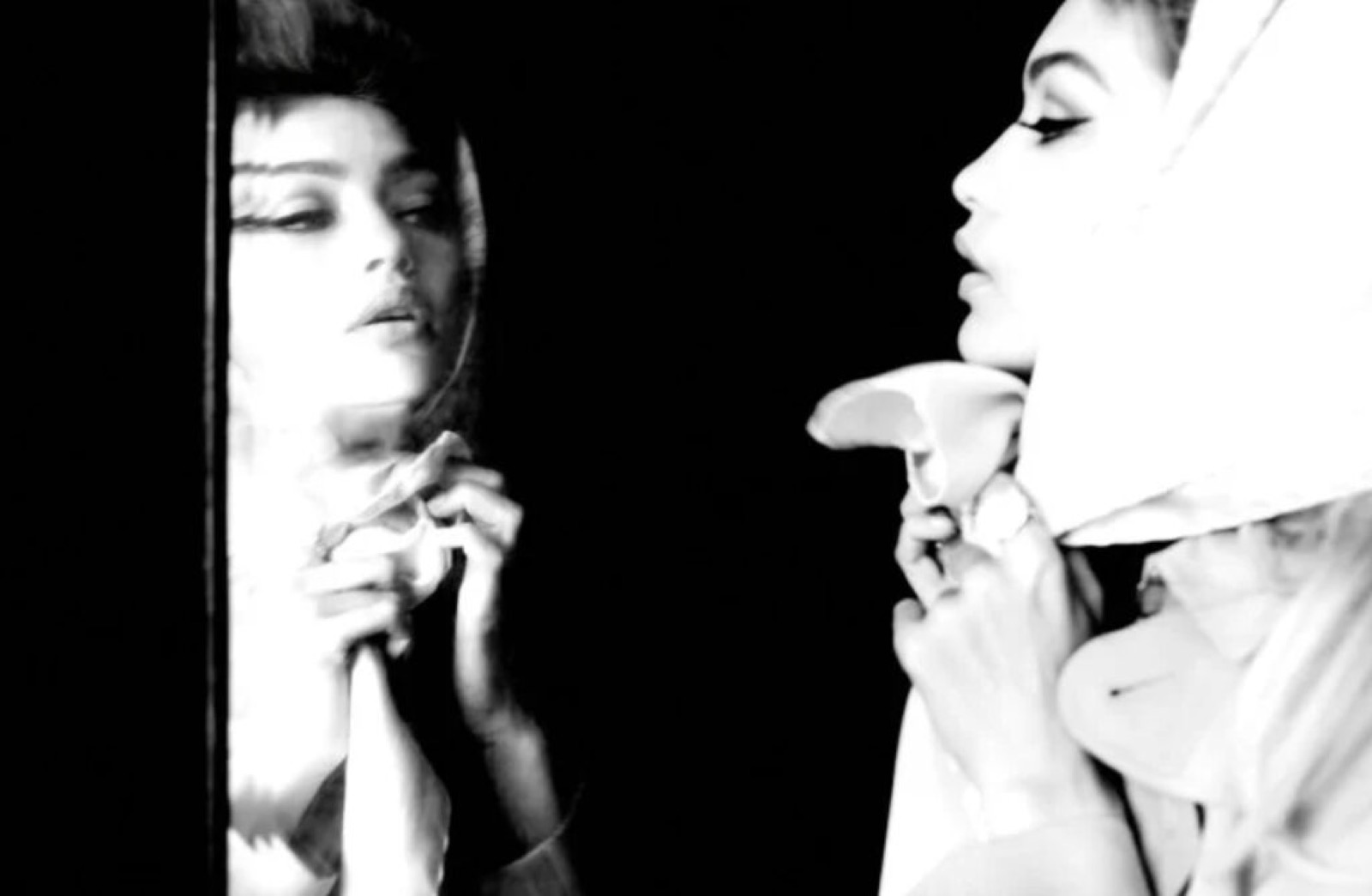

Most of the frame is withheld, given over to a black so complete it reads less as background than as everything the picture declines to name. Out of it, two faces surface: a woman in profile on the right and her reflection caught in a mirror to the left, joined and divided by the bright seam of the glass edge. A white head-wrap, a pale flower held to the throat, a sweep of winged liner. The rest is dark, and the darkness is the composition’s largest decision.
What the image shows, it shows twice and differently. The real profile is sharp-lit and closed-eyed, lifted as if listening; the reflection is softer, grainier, more dreamed than seen, so that the mirror behaves like memory rather than a surface. Between them the hands cradle a white bloom at the collarbone, a gesture of tending or of prayer. Nothing is explained. We are given a mood and denied its cause, which is exactly how the staged image works on us, offering intimacy while keeping its reasons offstage.
This is Steven Meisel in his most cinematic register, closer to a film still than a fashion plate, treating the studio as a stage for atmosphere rather than product. The man who defined Vogue Italia’s covers understood that withholding sells harder than display. The archival pigment print earns the low key: it holds that dense black without banding, keeps the shadow luminous rather than dead, and lets the few lit passages, face, flower, glass, glow at the threshold of legibility. The picture is, in the end, mostly what it withholds.