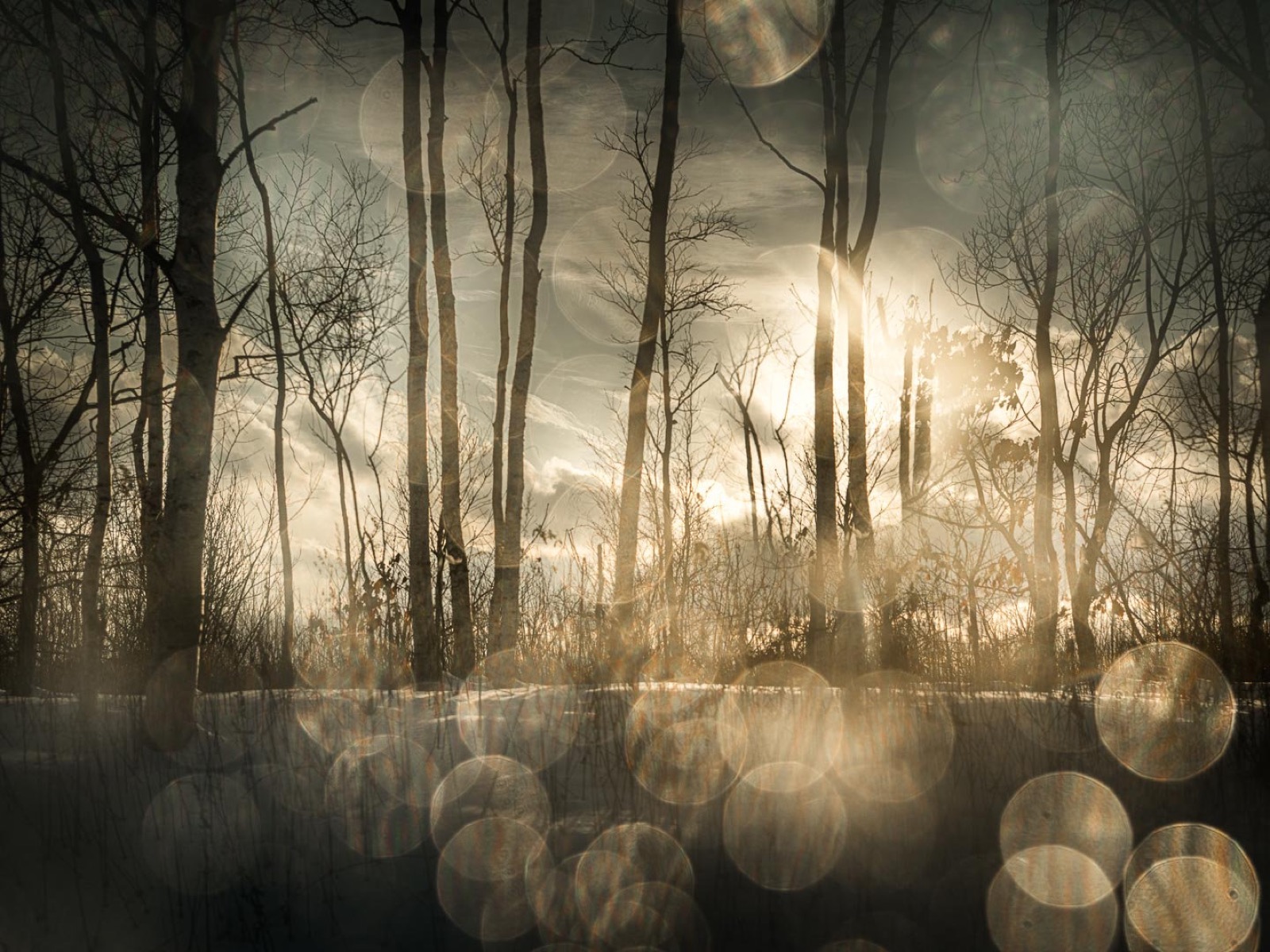
Ours is the era of the advance warning, and this winter wood belongs to it: bare trees over snow, a low gold sun straining through the trunks, and pale circles of flare drifting across everything like lanterns loosed from their strings. The siren tested at noon, the forecast that outruns the weather — the picture knows these rituals. Its series is called End Sends Advance Warning, and I believe it: something is being announced, gently, in a language of light.
The orbs are the picture’s rhetoric, and rhetoric can be admired calmly. What undoes my calm is smaller: to the right of the sun, one tree still carries its leaves, a dark crown among the skeletons, as if it had not received the notice the others obeyed. I keep returning to it. Disaster, the picture murmurs, will not arrive evenly; someone is always still in leaf when the light goes strange. The circles refuse to settle into meaning — breath on a window, cells under a lens, snow enlarged to moons. Their indecision is their truth.
Hido made his reputation among lit windows and fogged American roads; museums such as SFMOMA and the Whitney keep his night thoughts. Printed in archival pigment and mounted on aluminium Dibond, the image sits rigid and frameless, a votive panel rather than a page. I find the format just: a warning should be delivered flat, without tremble. And still the gold is tender. Whatever end is being announced, the announcement itself is beautiful, which may be the cruelest thing about it, or the kindest.
Ours is the era of the advance warning, and this winter wood belongs to it: bare trees over snow, a low gold sun straining through the trunks, and pale circles of flare drifting across everything like lanterns loosed from their strings. The siren tested at noon, the forecast that outruns the weather — the picture knows these rituals. Its series is called End Sends Advance Warning, and I believe it: something is being announced, gently, in a language of light.
The orbs are the picture’s rhetoric, and rhetoric can be admired calmly. What undoes my calm is smaller: to the right of the sun, one tree still carries its leaves, a dark crown among the skeletons, as if it had not received the notice the others obeyed. I keep returning to it. Disaster, the picture murmurs, will not arrive evenly; someone is always still in leaf when the light goes strange. The circles refuse to settle into meaning — breath on a window, cells under a lens, snow enlarged to moons. Their indecision is their truth.
Hido made his reputation among lit windows and fogged American roads; museums such as SFMOMA and the Whitney keep his night thoughts. Printed in archival pigment and mounted on aluminium Dibond, the image sits rigid and frameless, a votive panel rather than a page. I find the format just: a warning should be delivered flat, without tremble. And still the gold is tender. Whatever end is being announced, the announcement itself is beautiful, which may be the cruelest thing about it, or the kindest.