The room is withheld entirely: no floor, no horizon, only a wall of pale grey that could be anywhere or nowhere. It withholds her eyes as well, tucked under a blond fringe and the shelf of her brow, so that the face reads as bone and shadow before it reads as expression. What is left, once so much has been refused, is a matter of organization, a body bent into an arc, a mass of pink lifted against dark skin, and very little else to distract the attention.
Everything hangs from that curve. She leans forward with both hands laid flat on the thighs, red nails marking the lowest points of the design, and the ruffled magenta bodice swells outward at the shoulders like something inflated by breath. The light comes soft and even, glossing the arms and collarbone, and Yeste has set the strapless dress so that its riot of tulle sits exactly where the torso would otherwise be plainest. The picture is built from two facts, the skin and the pink, and it trusts them to carry it.
Yeste belongs to the front rank of Spanish fashion photographers, at home in Numéro and Harper’s Bazaar, and much of his best work turns on this kind of severe simplicity, an element and a body and nothing spare. Held as an archival pigment print, the magenta stays loud without bleeding and the darker passages of the skin keep their modelling, which is where the whole thing lives. It is a portrait that gives you a great deal by showing remarkably little, and knows the difference.
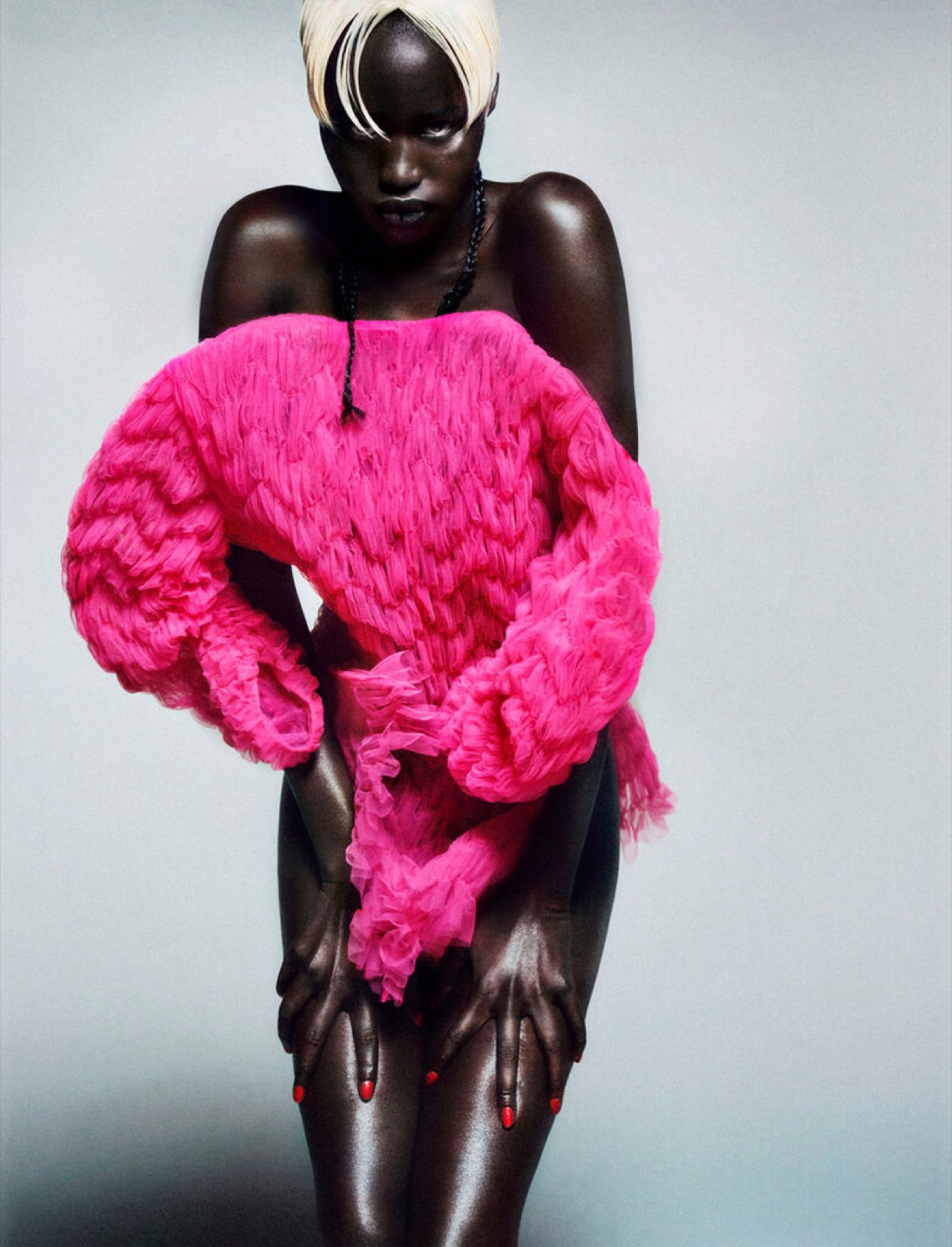

The room is withheld entirely: no floor, no horizon, only a wall of pale grey that could be anywhere or nowhere. It withholds her eyes as well, tucked under a blond fringe and the shelf of her brow, so that the face reads as bone and shadow before it reads as expression. What is left, once so much has been refused, is a matter of organization, a body bent into an arc, a mass of pink lifted against dark skin, and very little else to distract the attention.
Everything hangs from that curve. She leans forward with both hands laid flat on the thighs, red nails marking the lowest points of the design, and the ruffled magenta bodice swells outward at the shoulders like something inflated by breath. The light comes soft and even, glossing the arms and collarbone, and Yeste has set the strapless dress so that its riot of tulle sits exactly where the torso would otherwise be plainest. The picture is built from two facts, the skin and the pink, and it trusts them to carry it.
Yeste belongs to the front rank of Spanish fashion photographers, at home in Numéro and Harper’s Bazaar, and much of his best work turns on this kind of severe simplicity, an element and a body and nothing spare. Held as an archival pigment print, the magenta stays loud without bleeding and the darker passages of the skin keep their modelling, which is where the whole thing lives. It is a portrait that gives you a great deal by showing remarkably little, and knows the difference.