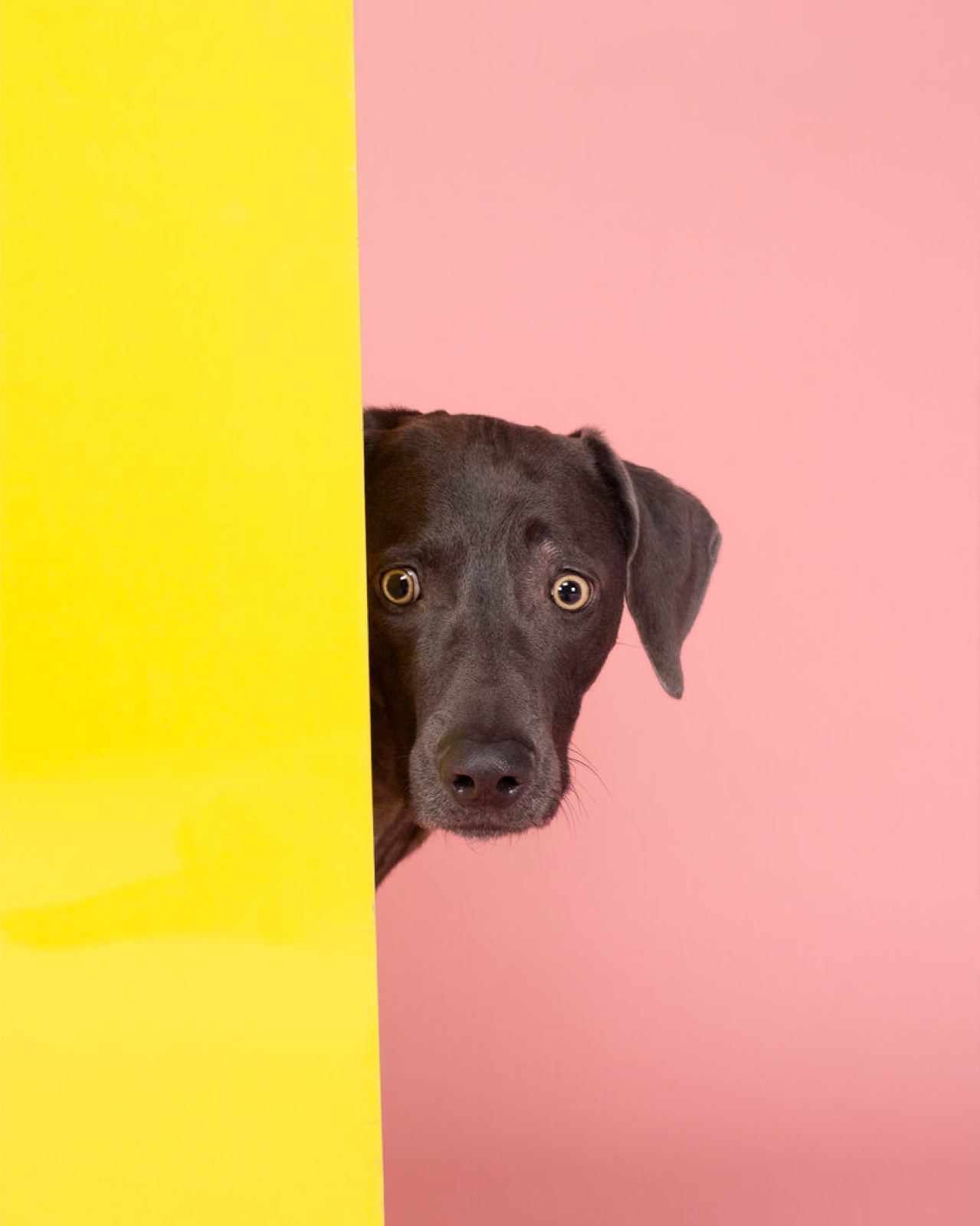
One breath ago the head was not yet here; one breath on, it may withdraw behind the yellow panel entirely. What the picture holds is the hesitation between, the instant when the chocolate Weimaraner has committed exactly half its face to the pink field and no more. One amber eye stares wide and rounded; the ear on the visible side hangs slack and heavy; the black nose, glossed and specific, breaks the plane at the center. The animal is caught neither entering nor retreating but suspended in the decision.
Wegman organizes the surprise with almost heraldic economy. The frame splits into two flat, saturated grounds, a lemon yellow at left, a dusty rose at right, and the seam between them becomes the edge the dog leans past. Nothing distracts: no floor, no horizon, no prop. The comedy and the tenderness both issue from that single wide eye, from the faint furrow above it, from the whiskers catching light against the darker muzzle.
Since the 1970s this artist has made his Weimaraners the deadpan instruments of a conceptual wit, testing how much feeling a straight-faced setup can carry. Here the joke, an intruder who is only a curious dog, never quite cancels the disquiet in the gaze, and that doubleness is the point. As a pigment print, the image keeps its color exact: the yellow stays acid, the pink stays powdery, the fur reads warm-black rather than muddy. The composure of the whole yields, cleanly, to one alarmed and lovely eye.
One breath ago the head was not yet here; one breath on, it may withdraw behind the yellow panel entirely. What the picture holds is the hesitation between, the instant when the chocolate Weimaraner has committed exactly half its face to the pink field and no more. One amber eye stares wide and rounded; the ear on the visible side hangs slack and heavy; the black nose, glossed and specific, breaks the plane at the center. The animal is caught neither entering nor retreating but suspended in the decision.
Wegman organizes the surprise with almost heraldic economy. The frame splits into two flat, saturated grounds, a lemon yellow at left, a dusty rose at right, and the seam between them becomes the edge the dog leans past. Nothing distracts: no floor, no horizon, no prop. The comedy and the tenderness both issue from that single wide eye, from the faint furrow above it, from the whiskers catching light against the darker muzzle.
Since the 1970s this artist has made his Weimaraners the deadpan instruments of a conceptual wit, testing how much feeling a straight-faced setup can carry. Here the joke, an intruder who is only a curious dog, never quite cancels the disquiet in the gaze, and that doubleness is the point. As a pigment print, the image keeps its color exact: the yellow stays acid, the pink stays powdery, the fur reads warm-black rather than muddy. The composure of the whole yields, cleanly, to one alarmed and lovely eye.