A turned back is photography’s oldest way of having it both ways: the body offered, the person withheld. This picture tests the proposition to its limit. A young man raises a white cotton shirt over his head, and as the fabric swallows his face he becomes pure torso, a column of sunlit skin from the shadowed channel of the spine to the black denim at his hips. We are given everything and told nothing. The one legible sign of a self, the face, is what the gesture erases.
Yet Weber slips one deliberate anomaly into an otherwise natural scene: a single black leather glove, gripping the shirt’s hem where a bare hand should be. On a beach, under a bleached sky, the glove is an absurdity, and it does the work of fashion photography, making us look twice at the ordinary act of getting dressed. It is the detail that admits this is a construction, not a snapshot, a picture aware of the long lineage of the male nude even while playing at candour.
Weber, who through the 1980s made the American body the subject of high fashion, keeps the tonal drama restrained: the shirt burns to white, the sky washes to almost nothing, and the description gathers in the back’s soft modelling. The gelatin silver print is where that economy pays out, holding the faint down of skin against paper-white cloth with no hard edge between them. An undressing that reveals a torso and conceals a face leaves us, oddly, more curious about the boy than any frontal portrait would.
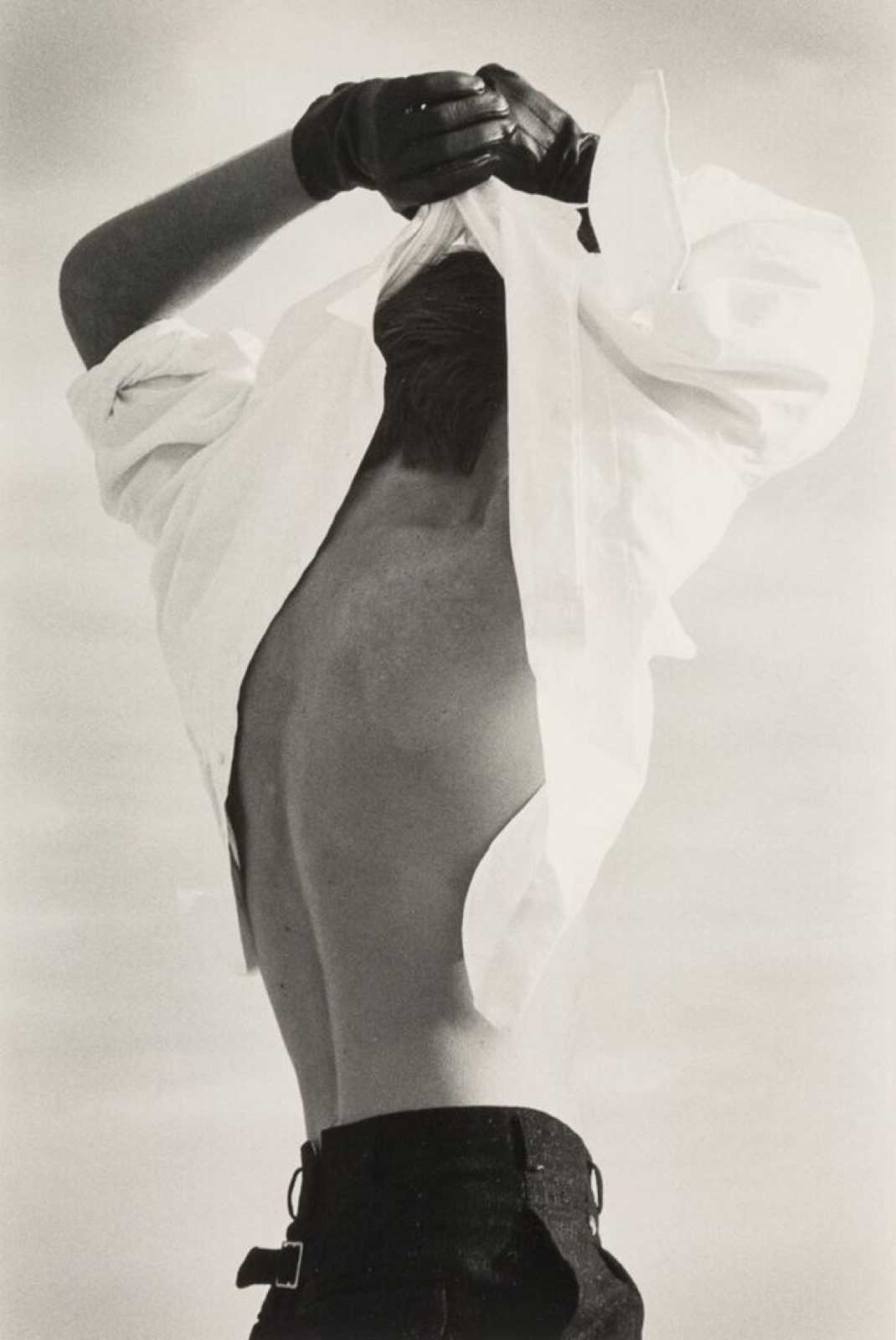

A turned back is photography’s oldest way of having it both ways: the body offered, the person withheld. This picture tests the proposition to its limit. A young man raises a white cotton shirt over his head, and as the fabric swallows his face he becomes pure torso, a column of sunlit skin from the shadowed channel of the spine to the black denim at his hips. We are given everything and told nothing. The one legible sign of a self, the face, is what the gesture erases.
Yet Weber slips one deliberate anomaly into an otherwise natural scene: a single black leather glove, gripping the shirt’s hem where a bare hand should be. On a beach, under a bleached sky, the glove is an absurdity, and it does the work of fashion photography, making us look twice at the ordinary act of getting dressed. It is the detail that admits this is a construction, not a snapshot, a picture aware of the long lineage of the male nude even while playing at candour.
Weber, who through the 1980s made the American body the subject of high fashion, keeps the tonal drama restrained: the shirt burns to white, the sky washes to almost nothing, and the description gathers in the back’s soft modelling. The gelatin silver print is where that economy pays out, holding the faint down of skin against paper-white cloth with no hard edge between them. An undressing that reveals a torso and conceals a face leaves us, oddly, more curious about the boy than any frontal portrait would.