A portrait becomes conceptual the moment its sitter is given a task. Here the task is balance: a small blue block rests on the crown of a Weimaraner's head, and the whole frame reorganises itself around keeping it there — the level amber gaze, the pendant ears hanging absolutely still, the long throat rising from a muscled chest like a plinth. The dog is not performing charm; it is concentrating. That concentration, sustained for the duration of the exposure, is the picture's true subject, and it is rendered with a gravity most photographers reserve for statesmen.
The object matters as much as the image. This is a unique Polacolor print from the fabled large-format Polaroid camera, its fringed pod edge left visible along the top, its title and signature pencilled into the lower margin. The one-shot chemistry burnishes the coat to a bronze warmth and lets the near-black ground absorb the studio entirely, so that the blue rectangle reads as pure geometry — a cool modernist swatch set on sentient fur. The humour is delivered deadpan, and deadpan is precisely how it earns its seriousness.
It is a small task with a long lineage. Since the early 1970s Wegman has used his dogs to test how much intelligence a photograph can carry — obedience exercises recast as meditations on form, trust and attention — and the results have entered the collections of the Museum of Modern Art and the Whitney, among others. That each of these Polaroids exists as a single print only sharpens the point: one dog, one block, one exposure, a balance that cannot be repeated.
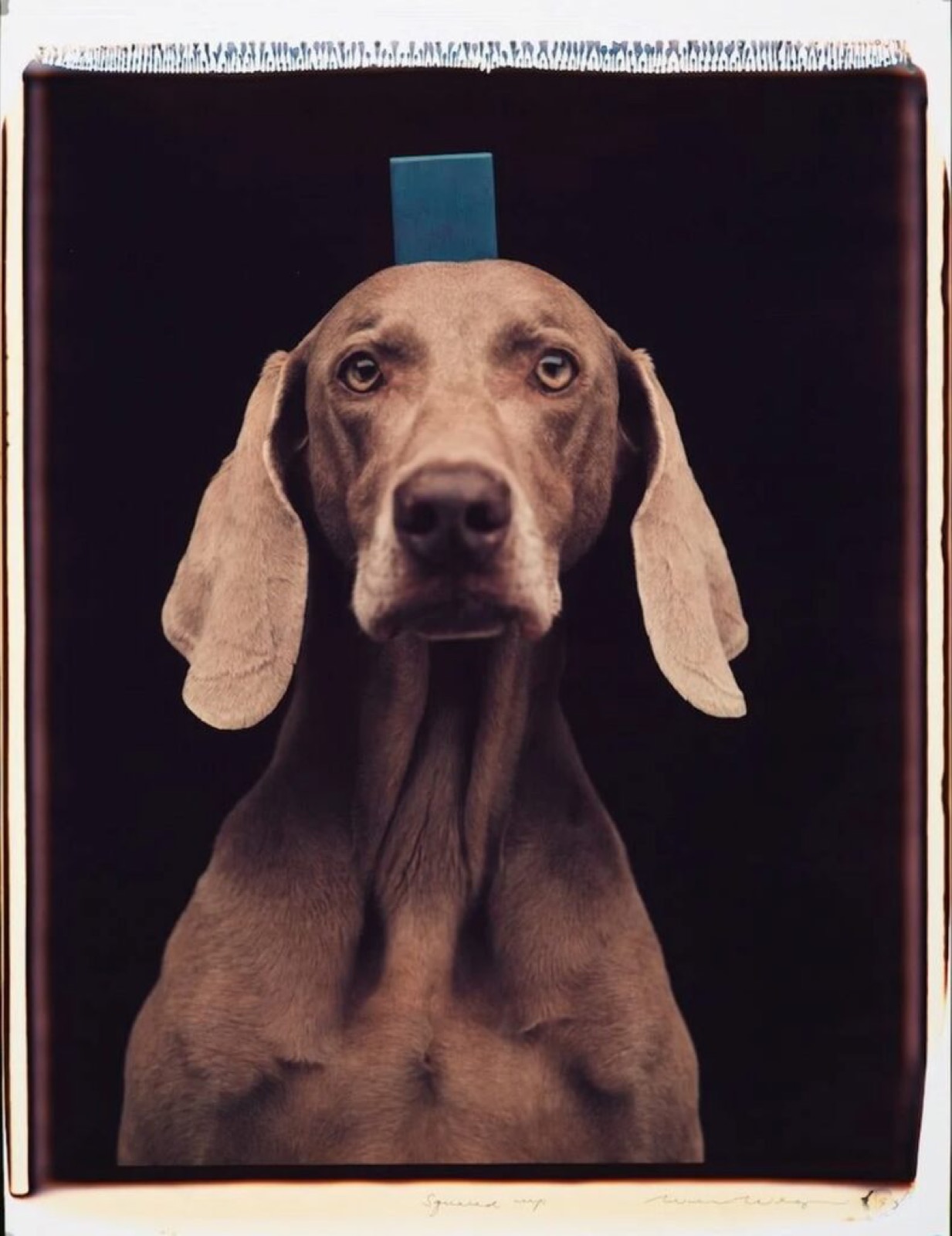
A portrait becomes conceptual the moment its sitter is given a task. Here the task is balance: a small blue block rests on the crown of a Weimaraner's head, and the whole frame reorganises itself around keeping it there — the level amber gaze, the pendant ears hanging absolutely still, the long throat rising from a muscled chest like a plinth. The dog is not performing charm; it is concentrating. That concentration, sustained for the duration of the exposure, is the picture's true subject, and it is rendered with a gravity most photographers reserve for statesmen.
The object matters as much as the image. This is a unique Polacolor print from the fabled large-format Polaroid camera, its fringed pod edge left visible along the top, its title and signature pencilled into the lower margin. The one-shot chemistry burnishes the coat to a bronze warmth and lets the near-black ground absorb the studio entirely, so that the blue rectangle reads as pure geometry — a cool modernist swatch set on sentient fur. The humour is delivered deadpan, and deadpan is precisely how it earns its seriousness.
It is a small task with a long lineage. Since the early 1970s Wegman has used his dogs to test how much intelligence a photograph can carry — obedience exercises recast as meditations on form, trust and attention — and the results have entered the collections of the Museum of Modern Art and the Whitney, among others. That each of these Polaroids exists as a single print only sharpens the point: one dog, one block, one exposure, a balance that cannot be repeated.