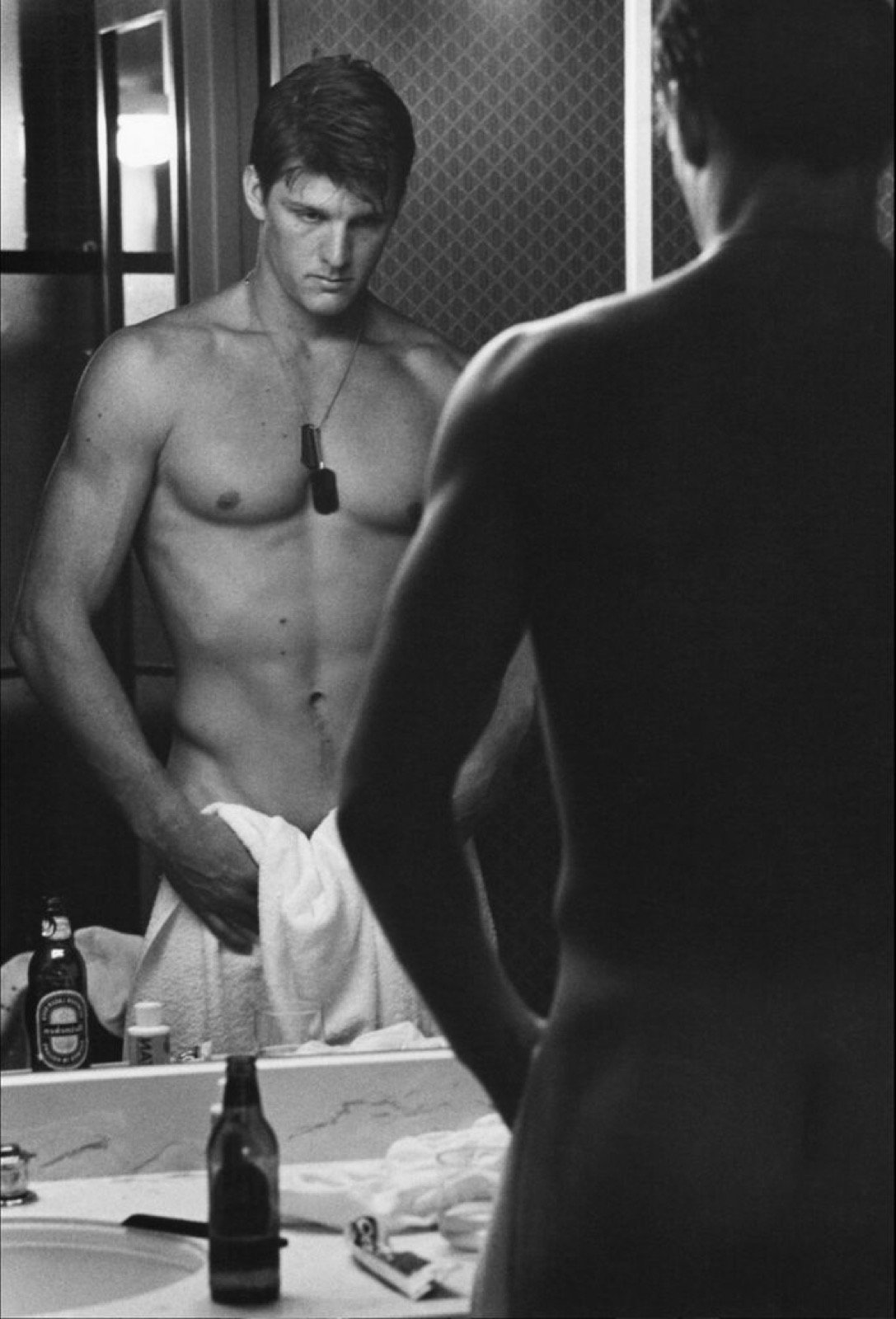
The doubled figure before a mirror is one of the oldest devices in Western picture-making, from the convex glass in Netherlandish painting to the vanities of the Baroque, and Weber works inside it. He gives us a young man twice: once as a dark back turned to us, close and unreadable, and once as a lit reflection across the sink, chest bare, military dog tags resting on the sternum, a white towel gathered at the hips. The two versions regard each other over a clutter of ordinary things.
On the counter with him sits a still life of the evening: a bottle of beer sweating in the foreground, a second bottle and a can set back, a pack of cigarettes and matches, a bar of soap, the cold marble of a hotel bathroom. This is Honolulu after dark, and the dog tags give it an undertow — a military town, a place through which young men in uniform have always passed on their way to somewhere graver. The towel and the beer say leisure; the tags remember the fleet.
Weber built a whole American mythology out of this tension — the sailor, the athlete, the beautiful young man poised between innocence and knowledge — and here he lets a single mirror carry it. The gelatin silver print deepens the drama, the near-black of the turned back pressing against the silvered light of the reflection, so that the man seems to study a brighter, more exposed version of himself. Whom does he see? Someone he half recognizes, holding a towel, wearing the name of a country around his neck.

The doubled figure before a mirror is one of the oldest devices in Western picture-making, from the convex glass in Netherlandish painting to the vanities of the Baroque, and Weber works inside it. He gives us a young man twice: once as a dark back turned to us, close and unreadable, and once as a lit reflection across the sink, chest bare, military dog tags resting on the sternum, a white towel gathered at the hips. The two versions regard each other over a clutter of ordinary things.
On the counter with him sits a still life of the evening: a bottle of beer sweating in the foreground, a second bottle and a can set back, a pack of cigarettes and matches, a bar of soap, the cold marble of a hotel bathroom. This is Honolulu after dark, and the dog tags give it an undertow — a military town, a place through which young men in uniform have always passed on their way to somewhere graver. The towel and the beer say leisure; the tags remember the fleet.
Weber built a whole American mythology out of this tension — the sailor, the athlete, the beautiful young man poised between innocence and knowledge — and here he lets a single mirror carry it. The gelatin silver print deepens the drama, the near-black of the turned back pressing against the silvered light of the reflection, so that the man seems to study a brighter, more exposed version of himself. Whom does he see? Someone he half recognizes, holding a towel, wearing the name of a country around his neck.