The mimosa seems to be dissolving even as we look at it, its tiny golden blossoms scattering into a haze of light and grain.
In Mimosas, 2021, Sarah Moon returns to the flowers that have long stood among her most beloved subjects, and once again the still life becomes a meditation on transience. Sprays of mimosa lean and tumble across the frame, their feathery foliage and beaded yellow flowers half-emerging from a warm, golden-brown atmosphere. Clusters of pale blossom glow in the lower corner; elsewhere the plant fades into shadow, more remembered than seen.
The surface itself seems weathered by time. Speckles, blooms, and soft blemishes drift across the image like dust or falling pollen, dissolving the boundary between the flowers and the ground that holds them. This is no pristine botanical record but a photograph that wears its own age, as if it had been kept for decades in a drawer and only now brought back into the light.
Moon has spoken of colour as another language, and here she speaks it in a single warm key — amber, ochre, antique gold — that lends the bouquet the tarnished radiance of an old painting. The carbon print process deepens this effect, delivering rich, granular tones and a soft, painterly texture that separates her work from any conventional flower study.
What moves us is the tenderness of the vanishing. The mimosa, emblem of early spring and fleeting brightness, is caught not at its peak but at the threshold of decay, where beauty thickens and begins to fade. In that trembling interval Moon finds her true subject: not the flower itself, but time passing over it, and the luminous melancholy of all things that bloom only to disappear.
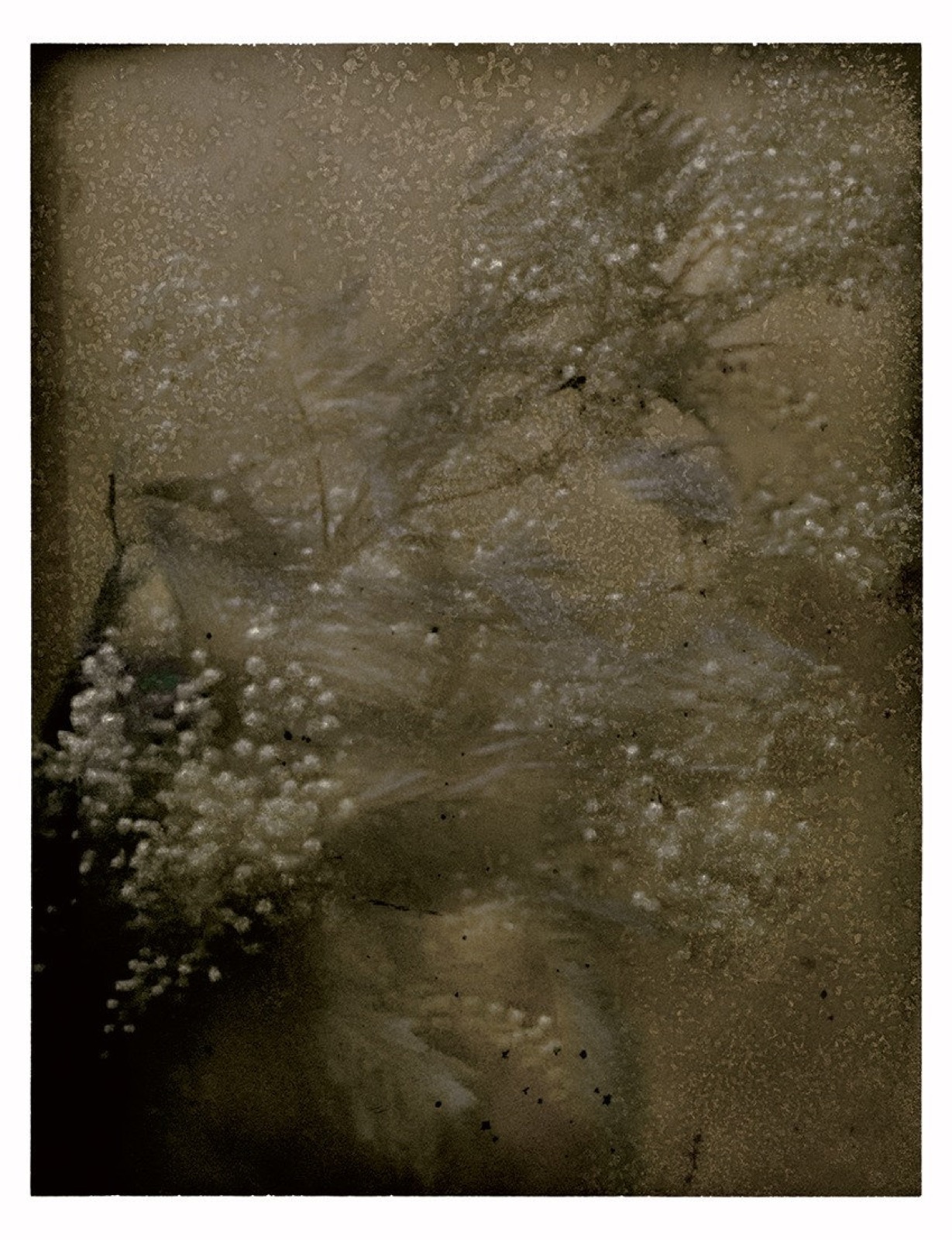

The mimosa seems to be dissolving even as we look at it, its tiny golden blossoms scattering into a haze of light and grain.
In Mimosas, 2021, Sarah Moon returns to the flowers that have long stood among her most beloved subjects, and once again the still life becomes a meditation on transience. Sprays of mimosa lean and tumble across the frame, their feathery foliage and beaded yellow flowers half-emerging from a warm, golden-brown atmosphere. Clusters of pale blossom glow in the lower corner; elsewhere the plant fades into shadow, more remembered than seen.
The surface itself seems weathered by time. Speckles, blooms, and soft blemishes drift across the image like dust or falling pollen, dissolving the boundary between the flowers and the ground that holds them. This is no pristine botanical record but a photograph that wears its own age, as if it had been kept for decades in a drawer and only now brought back into the light.
Moon has spoken of colour as another language, and here she speaks it in a single warm key — amber, ochre, antique gold — that lends the bouquet the tarnished radiance of an old painting. The carbon print process deepens this effect, delivering rich, granular tones and a soft, painterly texture that separates her work from any conventional flower study.
What moves us is the tenderness of the vanishing. The mimosa, emblem of early spring and fleeting brightness, is caught not at its peak but at the threshold of decay, where beauty thickens and begins to fade. In that trembling interval Moon finds her true subject: not the flower itself, but time passing over it, and the luminous melancholy of all things that bloom only to disappear.