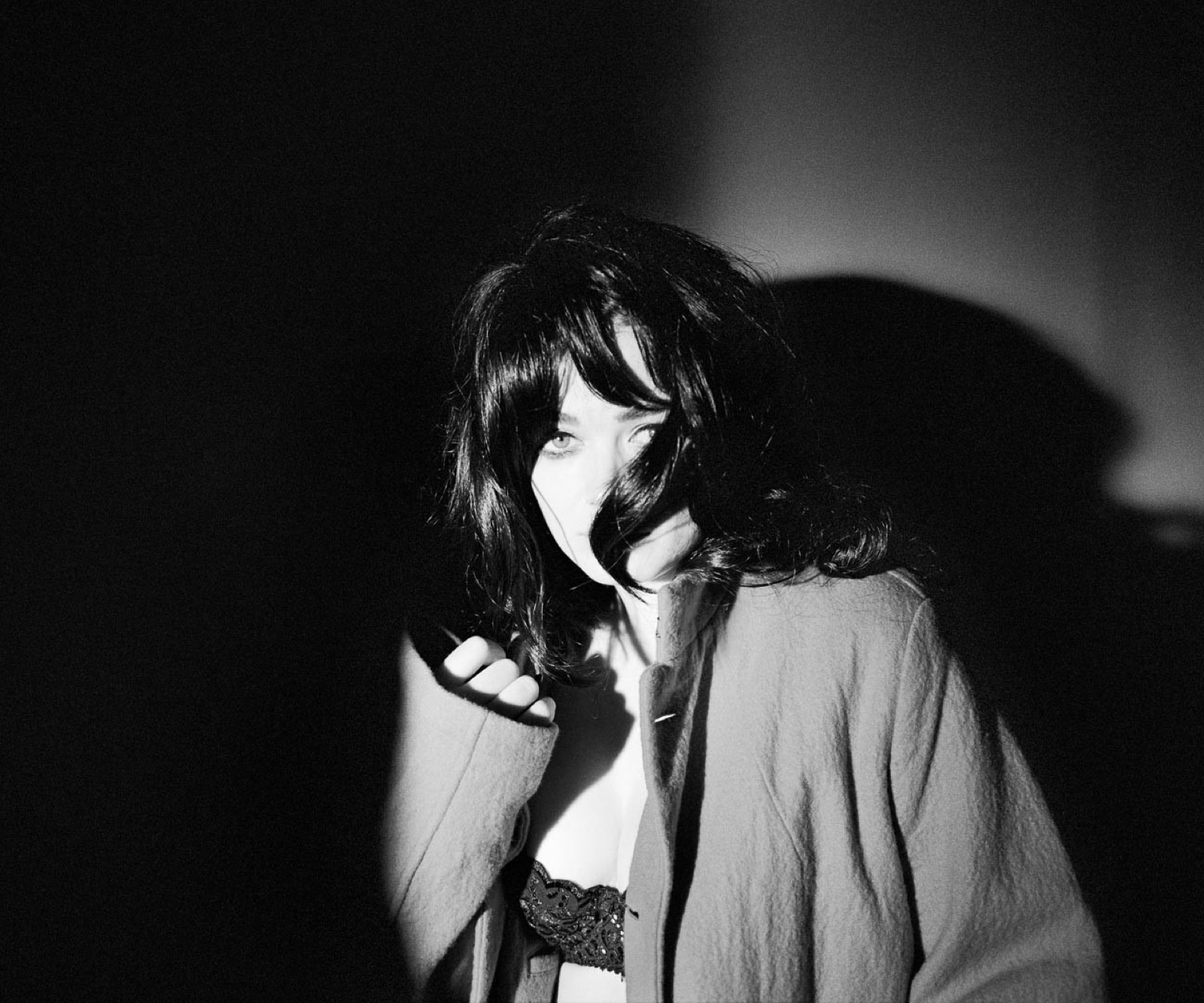
One eye, and only one, finds me. The rest of her face is lost behind a fall of dark, disordered hair; a coat slips from her shoulder over a band of black lace; a shaft of light cuts the dark room and throws her shadow, huge and soft, onto the wall behind. The scene is staged, plainly, this is a photograph that knows it is a photograph, and yet the staging is not what holds me.
What holds me is that single visible eye, gleaming through the hair, alert and unreadable. Around it I can assemble the general text: film-still glamour, the black-and-white grammar of intimacy and threat, the long history of women lit this way for cameras. That is the code, and I read it fluently. But the eye is not code. It is an address, sudden and particular, and it undoes the composure of everything I know about such pictures.
An archival pigment print on aluminium, unpublished, it belongs to Hido's more theatrical register, where the domestic tips toward the cinematic. I resist the temptation to write her story, because the picture has already refused it, withholding the mouth, the second eye, the name. What remains is the encounter itself: a look returned across the dark, meant, I cannot help feeling, for me, and for no one, in the impossible way of photographs.
One eye, and only one, finds me. The rest of her face is lost behind a fall of dark, disordered hair; a coat slips from her shoulder over a band of black lace; a shaft of light cuts the dark room and throws her shadow, huge and soft, onto the wall behind. The scene is staged, plainly, this is a photograph that knows it is a photograph, and yet the staging is not what holds me.
What holds me is that single visible eye, gleaming through the hair, alert and unreadable. Around it I can assemble the general text: film-still glamour, the black-and-white grammar of intimacy and threat, the long history of women lit this way for cameras. That is the code, and I read it fluently. But the eye is not code. It is an address, sudden and particular, and it undoes the composure of everything I know about such pictures.
An archival pigment print on aluminium, unpublished, it belongs to Hido's more theatrical register, where the domestic tips toward the cinematic. I resist the temptation to write her story, because the picture has already refused it, withholding the mouth, the second eye, the name. What remains is the encounter itself: a look returned across the dark, meant, I cannot help feeling, for me, and for no one, in the impossible way of photographs.