Archival pigment print mounted on aluminium Dibond.
One Size Only / 61 x 61 cm / 24 x 24 in
Hand-signed by the artist, with title, date, and edition number inscribed in ink on an archival label affixed to the reverse side of the mounted photograph
She does not face us, and that is the first kindness of the picture. Carlos Idun-Tawiah lets Grace turn her profile to the slatted afternoon, the brim of her tiered straw hat catching the light like the pages of a book held open to the sun. Her face is in shadow; she is given back to herself. What we are permitted instead is her shadow proper, thrown enormous across the sea-green wall, a second Grace who keeps her own counsel beside the small framed square, the basket of trailing leaves, the two cups waiting on their ledge.
Look at the white clutch held against the pale dress, both the same shade of remembered cream, and at the single strand of pearls at her collarbone catching one bar of light. These are the props of an occasion — church, a visit, a photograph to be taken later — and Idun-Tawiah stages them with the tenderness of someone working from a family album, the kind of Accra interior where a heavy curtain and an upholstered chair carry a whole century of aspiration. Even the refrigerator, hung with its little sugared magnets like sweets, belongs to the choreography of a household that dresses for its own dignity.
The light here does the moral work. It falls in stripes across her arm and skirt, marking time without spending it, holding her at the threshold of leaving. Idun-Tawiah, among the most quietly assured of the young Ghanaian image-makers, builds his pictures this way: Black life composed not as spectacle but as poise, a woman caught in the long second before she steps out of frame and into her own day.
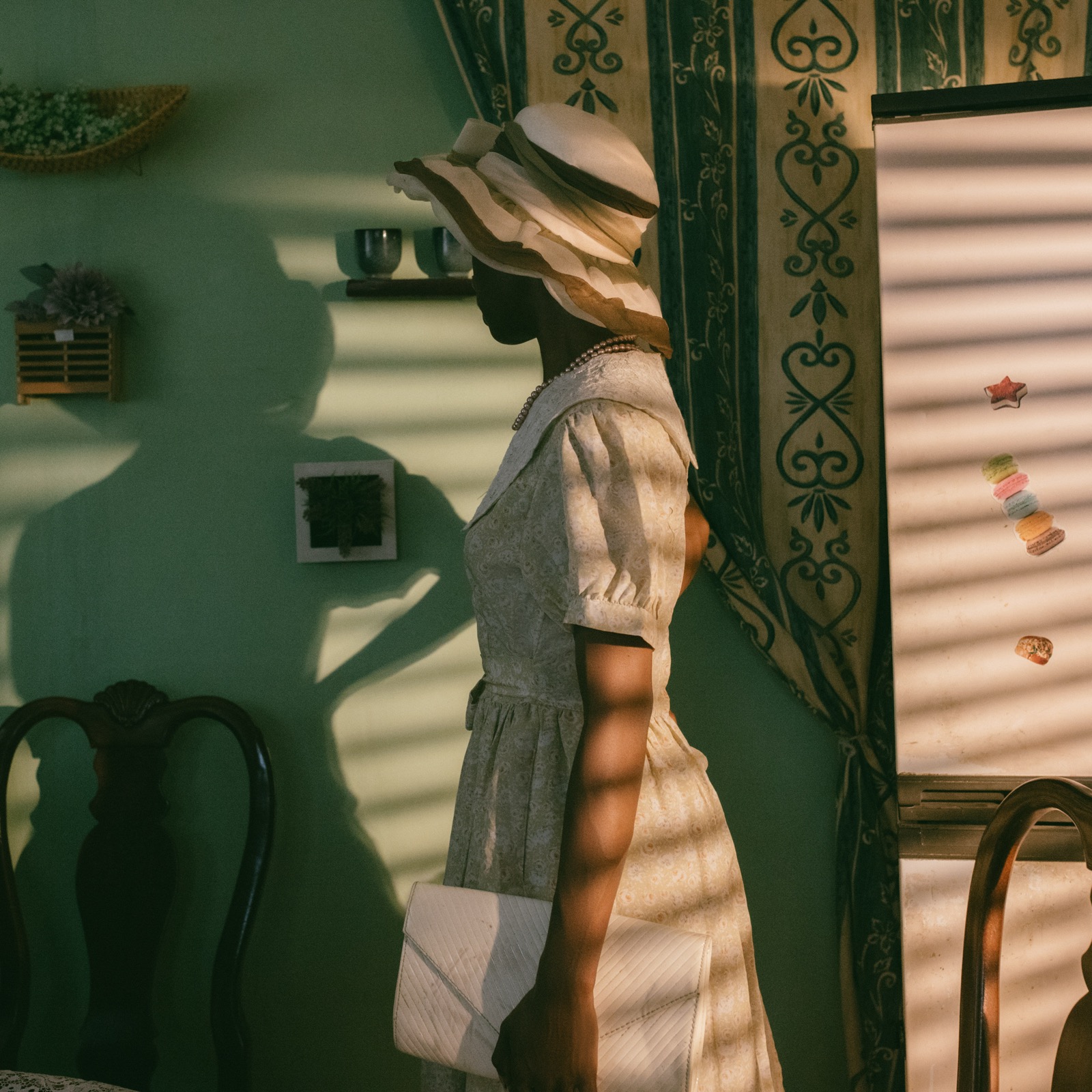

She does not face us, and that is the first kindness of the picture. Carlos Idun-Tawiah lets Grace turn her profile to the slatted afternoon, the brim of her tiered straw hat catching the light like the pages of a book held open to the sun. Her face is in shadow; she is given back to herself. What we are permitted instead is her shadow proper, thrown enormous across the sea-green wall, a second Grace who keeps her own counsel beside the small framed square, the basket of trailing leaves, the two cups waiting on their ledge.
Look at the white clutch held against the pale dress, both the same shade of remembered cream, and at the single strand of pearls at her collarbone catching one bar of light. These are the props of an occasion — church, a visit, a photograph to be taken later — and Idun-Tawiah stages them with the tenderness of someone working from a family album, the kind of Accra interior where a heavy curtain and an upholstered chair carry a whole century of aspiration. Even the refrigerator, hung with its little sugared magnets like sweets, belongs to the choreography of a household that dresses for its own dignity.
The light here does the moral work. It falls in stripes across her arm and skirt, marking time without spending it, holding her at the threshold of leaving. Idun-Tawiah, among the most quietly assured of the young Ghanaian image-makers, builds his pictures this way: Black life composed not as spectacle but as poise, a woman caught in the long second before she steps out of frame and into her own day.