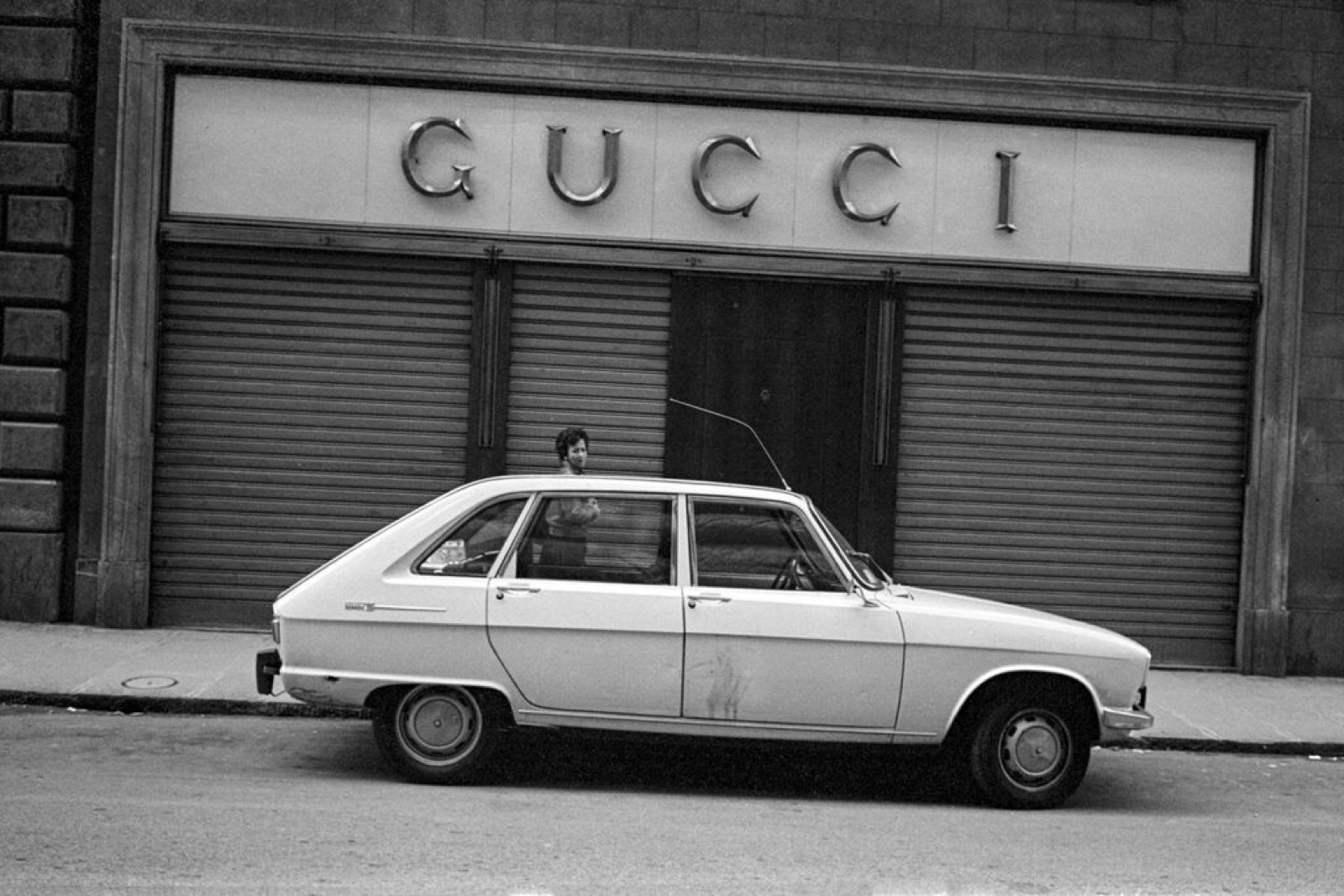
Whose name is on the ballot? The one running for office across this Roman-looking street is GUCCI, spelled out in fat chrome capitals above a shopfront sealed behind corrugated shutters. The title makes the joke explicit, vote Gucci, as if a fashion house were a candidate, its logo a slogan you could pull a lever for. Winter has caught the label at its most imperial and its least available: the store is shut, the letters gleam anyway.
Below the sign, a pale little hatchback stands at the curb, aerial raised like a thin baton, and behind its windows a dark-haired woman pauses on the sidewalk, caught mid-glance. She is the one flesh-and-blood constituent in a picture otherwise given over to commerce and stone. The everyday car, humble and dented with use, plays perfectly against the swagger overhead; the whole frame becomes a small essay on wanting, on the distance between the shuttered boutique and the street that must drive past it. It is glamour observed from the pavement, and it holds.
Winter, an American with a taste for the plainly seen, prints this in gelatin silver, and monochrome flatters the branding: the chrome letters read like jewelry, the shutters like a stage curtain rung down for the night. No people shop, no goods show; only the name performs. A photographer less sly would have shot the window display. This one shot the closed door and the parked runabout and let the caption do the campaigning, a wink at the theater of the label that never once raises its voice.
Whose name is on the ballot? The one running for office across this Roman-looking street is GUCCI, spelled out in fat chrome capitals above a shopfront sealed behind corrugated shutters. The title makes the joke explicit, vote Gucci, as if a fashion house were a candidate, its logo a slogan you could pull a lever for. Winter has caught the label at its most imperial and its least available: the store is shut, the letters gleam anyway.
Below the sign, a pale little hatchback stands at the curb, aerial raised like a thin baton, and behind its windows a dark-haired woman pauses on the sidewalk, caught mid-glance. She is the one flesh-and-blood constituent in a picture otherwise given over to commerce and stone. The everyday car, humble and dented with use, plays perfectly against the swagger overhead; the whole frame becomes a small essay on wanting, on the distance between the shuttered boutique and the street that must drive past it. It is glamour observed from the pavement, and it holds.
Winter, an American with a taste for the plainly seen, prints this in gelatin silver, and monochrome flatters the branding: the chrome letters read like jewelry, the shutters like a stage curtain rung down for the night. No people shop, no goods show; only the name performs. A photographer less sly would have shot the window display. This one shot the closed door and the parked runabout and let the caption do the campaigning, a wink at the theater of the label that never once raises its voice.