Hand-signed by the artist, with title, date, and edition number inscribed in ink on an archival label affixed to the reverse side of the mounted photograph.
The face is upside down. That is the first thing, and it does not let go of me: a girl's pale face surfacing at the lower left, chin where the brow should be, eyes open and turned up toward a sky we cannot see. Everything else in the frame obeys gravity — the heavy crimson clusters on the left, the vast violet drift of rhododendron filling the right two-thirds — and she alone is reversed, as if she had been laid down in the dark green and the whole bush had kept growing around her. The inversion is the wound. It turns sleep into something stranger, turns a child into a flower among flowers.
I keep returning to her eyes. They are not closed in the easy dream this picture could have been; they are open, faintly catching light, and they make her a witness rather than an offering. Around that small wet gleam the foliage goes nearly black, so that the blooms seem to hold their own illumination — the deep red on one side, the cool mauve on the other, a divided garden she lies along the seam of. The dark does most of the work. It eats the edges, presses the colour forward, and leaves only this: petals, leaves, and a face that belongs to both.
The girl is Scout, the photographer's daughter, who has moved through this Maine work for years until she is less a model than a recurring word in a private language. Cig Harvey makes pictures that I would call botanical and maternal at once, large saturated colour held in museum and private collections, and here in Camden she has done the quietest dangerous thing — placed her own child face-up into the underworld of a flowering shrub and let her open her eyes. I cannot look at it without flinching, and I cannot stop looking. That is the proof.
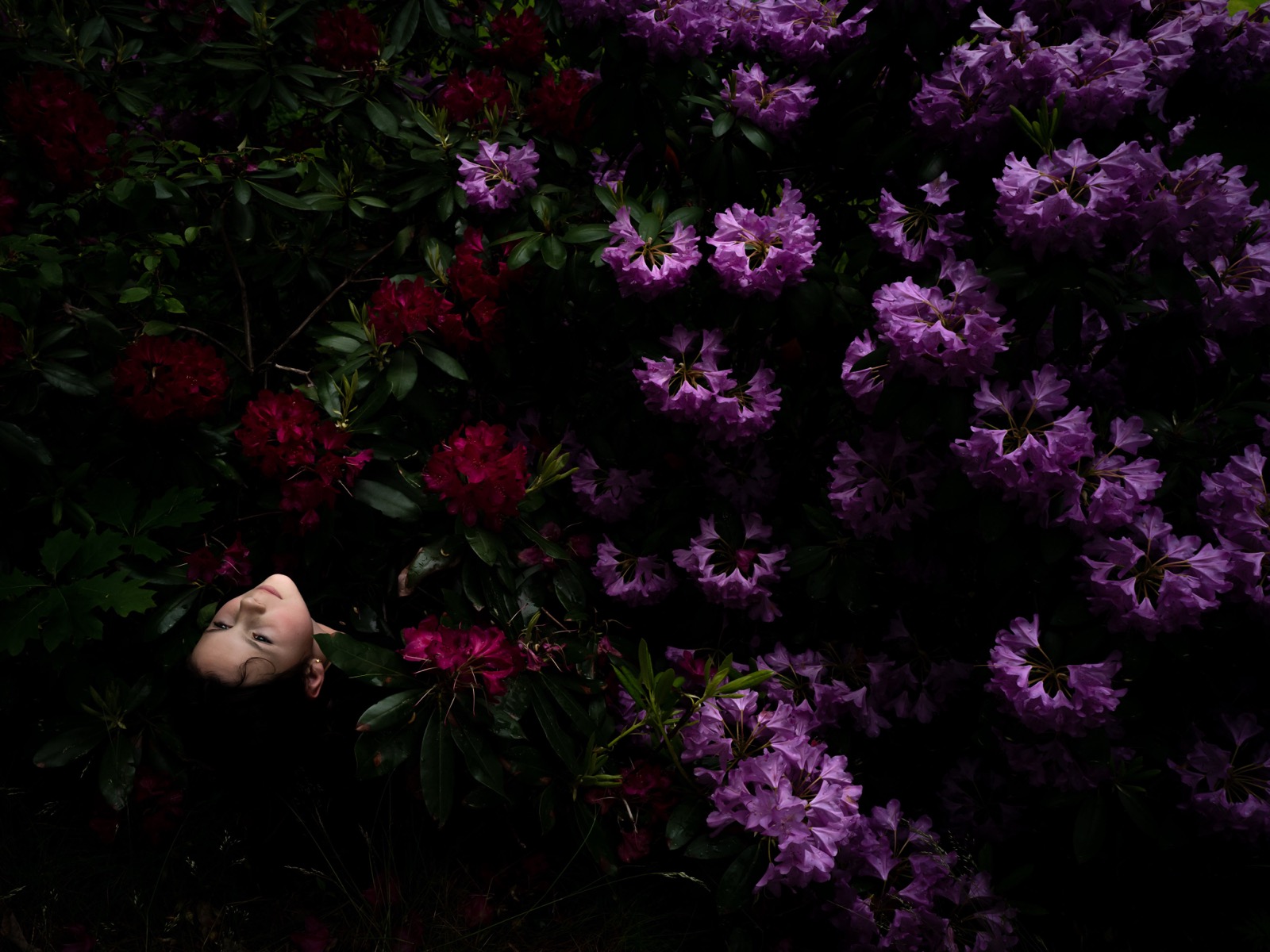

The face is upside down. That is the first thing, and it does not let go of me: a girl's pale face surfacing at the lower left, chin where the brow should be, eyes open and turned up toward a sky we cannot see. Everything else in the frame obeys gravity — the heavy crimson clusters on the left, the vast violet drift of rhododendron filling the right two-thirds — and she alone is reversed, as if she had been laid down in the dark green and the whole bush had kept growing around her. The inversion is the wound. It turns sleep into something stranger, turns a child into a flower among flowers.
I keep returning to her eyes. They are not closed in the easy dream this picture could have been; they are open, faintly catching light, and they make her a witness rather than an offering. Around that small wet gleam the foliage goes nearly black, so that the blooms seem to hold their own illumination — the deep red on one side, the cool mauve on the other, a divided garden she lies along the seam of. The dark does most of the work. It eats the edges, presses the colour forward, and leaves only this: petals, leaves, and a face that belongs to both.
The girl is Scout, the photographer's daughter, who has moved through this Maine work for years until she is less a model than a recurring word in a private language. Cig Harvey makes pictures that I would call botanical and maternal at once, large saturated colour held in museum and private collections, and here in Camden she has done the quietest dangerous thing — placed her own child face-up into the underworld of a flowering shrub and let her open her eyes. I cannot look at it without flinching, and I cannot stop looking. That is the proof.