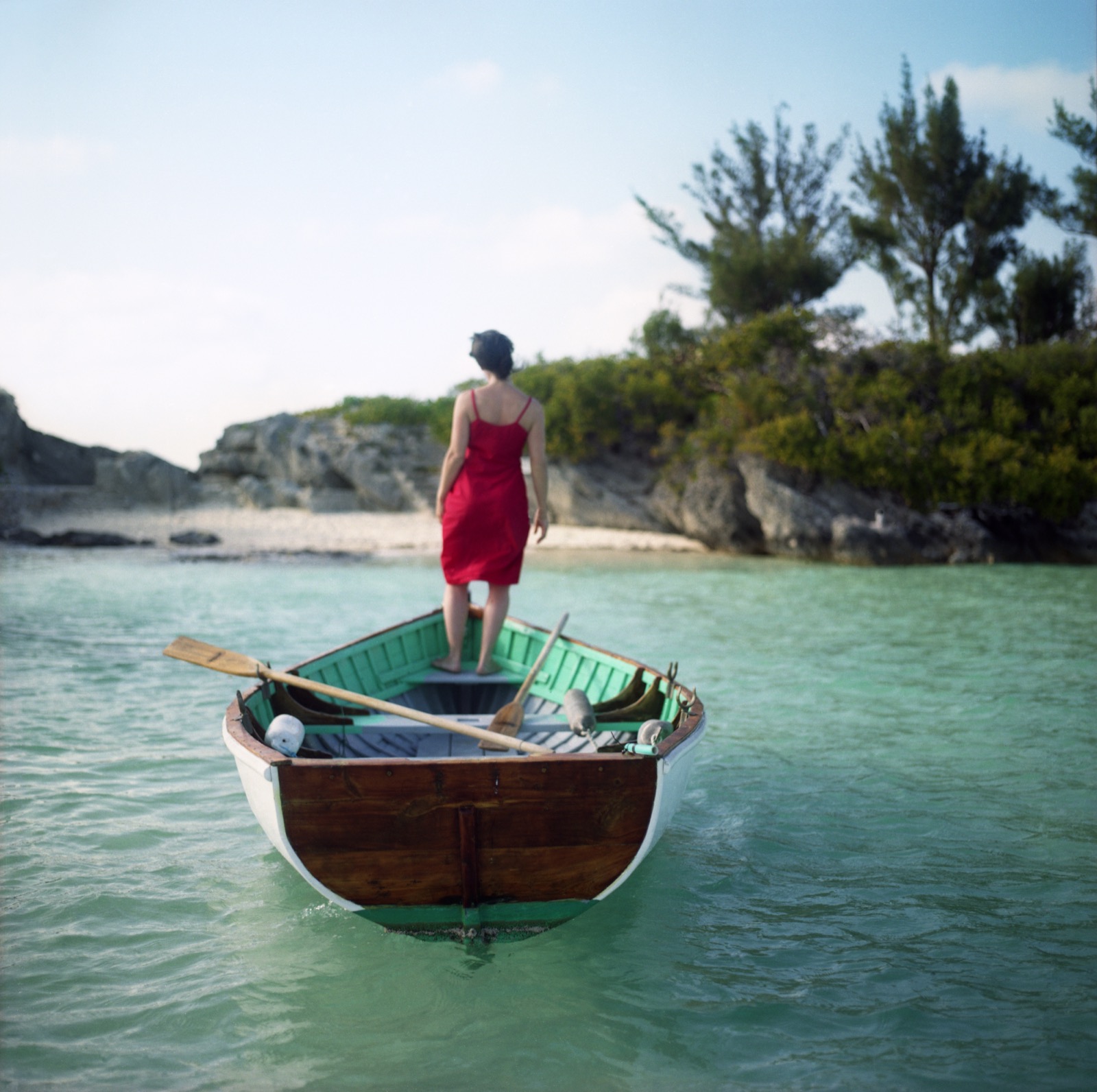
Flood Tide, Self-portrait, Mangrove Bay, Bermuda, 2005
Archival Pigment Print.
35.6 x 35.6 cm / 14 x 14 in
71.1 x 71.1 cm / 28 x 28 in
101.6 x 101.6 cm / 40 x 40 in
Hand-signed by the artist, with title, date, and edition number inscribed in ink on an archival label affixed to the reverse side of the mounted photograph.
Her face is the one thing this photograph declines to give. A self-portrait, the title insists, and yet the woman in the red dress keeps her back to us, balanced barefoot in the bow of a wooden dinghy, looking toward a shore we see only in fragments of limestone and sand. The oars lie shipped and crossed behind her, unhanded; whatever effort carried the boat this far has already ended. What remains is a figure suspended between departure and arrival, withholding exactly what portraiture is expected to deliver — an expression, a gaze.
Harvey made the picture in Bermuda in 2005, early in the self-portraits that preceded the family work for which she is now widely admired. Its construction is exact. The dinghy's interior is painted a mint green that repeats the shallows of Mangrove Bay note for note, so the red slip dress becomes the single heated color in a field of cool water and pale rock. I imagine her wading out, setting the camera, climbing aboard, standing still while the hull swung slowly on its own reflection. The square frame holds everything in unusual calm: buoys, casuarina trees, a ribbon of beach.
That calm is deceptive. Harvey understands that a turned back is an invitation, that concealment sharpens attention. Her lush, sensory color photographs — gathered in monographs from You Look At Me Like An Emergency to Blue Violet, exhibited and collected internationally — began in pictures like this one: a woman poised on green water, facing away, keeping her own counsel. This archival pigment print preserves that saturated stillness, an early key to everything that followed.

Her face is the one thing this photograph declines to give. A self-portrait, the title insists, and yet the woman in the red dress keeps her back to us, balanced barefoot in the bow of a wooden dinghy, looking toward a shore we see only in fragments of limestone and sand. The oars lie shipped and crossed behind her, unhanded; whatever effort carried the boat this far has already ended. What remains is a figure suspended between departure and arrival, withholding exactly what portraiture is expected to deliver — an expression, a gaze.
Harvey made the picture in Bermuda in 2005, early in the self-portraits that preceded the family work for which she is now widely admired. Its construction is exact. The dinghy's interior is painted a mint green that repeats the shallows of Mangrove Bay note for note, so the red slip dress becomes the single heated color in a field of cool water and pale rock. I imagine her wading out, setting the camera, climbing aboard, standing still while the hull swung slowly on its own reflection. The square frame holds everything in unusual calm: buoys, casuarina trees, a ribbon of beach.
That calm is deceptive. Harvey understands that a turned back is an invitation, that concealment sharpens attention. Her lush, sensory color photographs — gathered in monographs from You Look At Me Like An Emergency to Blue Violet, exhibited and collected internationally — began in pictures like this one: a woman poised on green water, facing away, keeping her own counsel. This archival pigment print preserves that saturated stillness, an early key to everything that followed.